



AKG
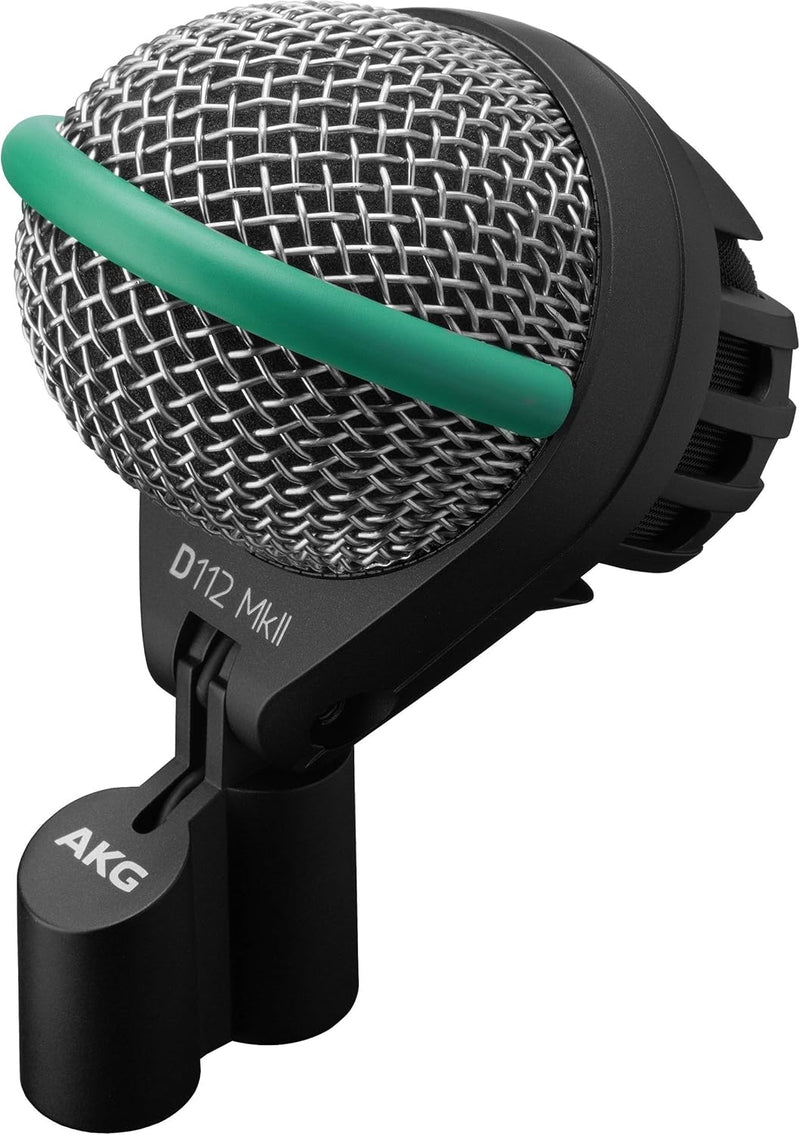
AKG D112 MKII Professional Bass Drum Microphone
The D112 MKII's internal bass resonance chamber delivers the punchy, attack-forward kick drum sound that front-of-house engineers reach for on stages worldwide.
$259.00*
View on Amazon
✓ In Stock on Amazon.com
*Price sourced from Amazon.com. Last updated:Oct 21, 2026.Price and availability are subject to change — details.
Affiliate Disclosure: As an Amazon Associate, Studio Supplies earns from qualifying purchases made through links on this page, at no additional cost to you. This helps support our editorial team.
Notice a mistake? Let Us Know
Overview
Key Features
Integrated flexible mount makes it even more versatile
Bass resonance volume chamberfor unique, punchy sound
Large diaphragm dynamic microphone delivers accurate low frequencies
Integrated hum-compensation coil keeps noise to an absolute minimum
Established as an industry-standard kick drum microphone
Specifications
Transducer Type
Large diaphragm dynamic
Polar Pattern
Cardioid
Frequency Response
20Hz – 17,000Hz
Sensitivity
1.8 mV/Pa
Output Impedance
210 Ohms
Connector
Balanced XLR 3-pin
Phantom Power Required
No
Hum Compensation
Integrated hum-compensation coil
Mount
Integrated flexible mount (MKII)
Dimensions
115mm length x 126mm height x 70mm diameter
Weight
300g (mic body only)
Frequently Asked Questions
Does the D112 MKII require phantom power?
No. The D112 MKII is a dynamic microphone and operates entirely without phantom power. It presents a 210-ohm output impedance and connects directly to any balanced XLR mic preamp input. Applying phantom power will not damage it, but it provides no benefit.
Where should the D112 MKII be positioned inside the kick drum for the best sound?
Placement significantly shapes the D112 MKII's output. Positioning it closer to the beater produces a harder, more attack-forward transient snap — useful in dense rock or metal mixes. Moving it back toward the center or batter head produces a rounder, fuller low-end weight. The integrated flexible mount on the MKII gives you continuous in-hole repositioning without needing a separate stand arm inside the shell.
What is the frequency range, and does the D112 MKII handle the sub frequencies of modern tuned kick drums?
The D112 MKII covers 20Hz to 17kHz. The low-frequency response extends fully into the sub-bass range where a tuned kick drum fundamentally resonates — typically between 50Hz and 100Hz — and the presence peak around 4kHz is engineered to capture the beater attack transient that cuts through a dense mix without requiring aggressive EQ additions.
Can the D112 MKII handle high SPL from a loud drummer in an untreated room?
Yes. The large diaphragm dynamic design is inherently resistant to SPL overload — it does not clip at the capsule level the way condenser microphones can. The D112 MKII is rated for high SPL applications and will handle even a heavy-footed drummer in a live or rehearsal environment without distortion.
Does the hum-compensation coil make a practical difference in live environments with stage lighting or transformers nearby?
The integrated hum-compensation coil is an additional winding wound in reverse polarity to the main coil. It cancels electromagnetic interference from nearby sources — stage dimmers, lighting rigs, power transformers — by rejecting the common-mode hum that single-coil dynamics can pick up. In a live environment with significant EM interference, this is a tangible noise floor advantage.
Related Products


