



Alesis
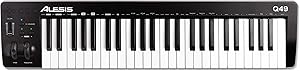
Alesis Q49 MKII 49-Key USB MIDI Keyboard Controller
Forty-nine full-size velocity-sensitive keys and dedicated transport controls make the Q49 MKII a studio-ready MIDI workhorse for production and performance.
$109.00*
Check availability
*Price sourced from Amazon.com. Last updated:Oct 23, 2026.Price and availability are subject to change — details.
Affiliate Disclosure: As an Amazon Associate, Studio Supplies earns from qualifying purchases made through links on this page, at no additional cost to you. This helps support our editorial team.
Notice a mistake? Let Us Know
Overview
Key Features
Music Production and Beat Maker Essential – USB powered MIDI controller with 49 full size MIDI keyboard velocity-sensitive keys for studio production, virtual synthesizer control and beat production
Complete Control - Octave / Transpose buttons to access the full piano range; Pitch bend and modulation wheels; Assignable volume knob and transport controls for tactile DAW and virtual synth control
Universal Compatibility - Complete compatibility with any music production app that accepts a MIDI controller including Ableton Live, Cubase, Logic, MPC Beats and more
Make Music Anywhere - Works with iOS devices for use with apps including Garageband, via the Apple Lightning to USB Camera Adapter (sold separately)
Professional Software Suite Included - Akai Professional MPC Beats including seven expansion packs: Producer Kits, LoFi Producer Collection, Trap Soul & LoFi Beats, Soulful Drums, Deep House, F9 Instruments Library, Urban Roulette, and 60 free MIDI controller lessons from Melodics
Specifications
Brand
Alesis
Model
Q49 MKII
Keys
49 full-size velocity-sensitive synth-action keys
Controls
Pitch Bend wheel, Modulation wheel, Assignable volume knob, Octave/Transpose buttons, Transport controls
Connectivity
USB (bus-powered)
iOS Compatibility
Yes, via Apple Lightning to USB Camera Adapter (sold separately)
Driver Requirement
Class-compliant, no driver needed
Compatible Platforms
Mac, PC, iOS
Included Software
Akai Professional MPC Beats (7 expansion packs), 60 Melodics MIDI lessons
Frequently Asked Questions
How do the Q49 MKII's 49 full-size keys compare to a standard piano, and is the octave range sufficient for most production tasks?
Forty-nine full-size keys cover just over four octaves — enough for two-handed playing, chord voicings with both hands, and most melodic runs without shifting octave. The dedicated Octave Up/Down buttons extend the accessible range across all 128 MIDI notes when needed, making the Q49 MKII genuinely sufficient for lead lines, pads, bass, and full arrangement work in a single session.
Does the Q49 MKII require drivers, and how does it integrate with Ableton Live, Logic Pro, and Cubase?
The Q49 MKII is USB class-compliant — no drivers required on Mac or PC. In Ableton Live, Logic Pro X, and Cubase, it appears as a MIDI input device on connection and is immediately assignable to any MIDI track. The transport controls map to DAW transport functions in most major DAWs, though specific mapping may require a brief MIDI learn step depending on your software.
What do the pitch bend and modulation wheels add to the Q49 MKII compared to controllers with only buttons for those functions?
Continuous wheels provide analog-style control — you can apply gradual pitch vibrato, slow filter sweeps, or nuanced mod wheel expressions that buttons, which send stepped or on/off values, can't replicate. For live performance or expressive MIDI recording of synth leads and string patches, the difference in feel and musical output is significant.
Can the Q49 MKII's assignable volume knob control parameters beyond volume in a DAW?
Yes. The assignable knob transmits a MIDI CC value that can be mapped to any automatable parameter in your DAW or virtual instrument — send levels, filter resonance, reverb size, or virtually any macro in a software synth. MIDI learn in Ableton, Logic, or similar software handles the assignment in a few clicks.
Does the Q49 MKII work with iOS devices?
Yes, with the Apple Lightning to USB Camera Adapter (sold separately). Once connected via the adapter, the Q49 MKII functions as a class-compliant MIDI controller in iOS music apps including GarageBand and other Core MIDI-compatible apps.
Related Products


