



Alesis
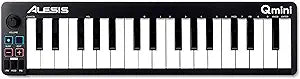
Alesis Qmini 32-Key Portable USB MIDI Keyboard
Compact 32-key USB MIDI controller with velocity-sensitive mini keys that puts beat production and synth performance in your laptop bag.
Check availability
Affiliate Disclosure: As an Amazon Associate, Studio Supplies earns from qualifying purchases made through links on this page, at no additional cost to you. This helps support our editorial team.
Notice a mistake? Let Us Know
Overview
Key Features
Music Production and Beat Maker Essential – USB powered MIDI controller with 32 mini MIDI keyboard velocity-sensitive keys for studio production, virtual synthesizer control and beat production
Complete Control - Octave / Transpose buttons for access of the full piano range; Pitch bend and modulation buttons; Assignable volume knob for tactile control of any DAW or Synth parameter
Universal Compatibility - Complete compatibility with any music production app that accepts a MIDI controller including Ableton Live, Cubase, Logic, MPC Beats and more
Make Music Anywhere - Works with iOS devices for use with apps including Garageband, via the Apple Lightning to USB Camera Adapter (sold separately)
Professional Software Suite Included - Akai Professional MPC Beats including seven expansion packs: Producer Kits, LoFi Producer Collection, Trap Soul & LoFi Beats, Soulful Drums, Deep House, F9 Instruments Library, Urban Roulette, and 60 free MIDI controller lessons from Melodics
Specifications
Brand
Alesis
Model
Qmini
Keys
32 mini velocity-sensitive synth-action keys
Controls
Octave/Transpose buttons, Pitch Bend button, Modulation button, Assignable volume knob
Connectivity
USB (bus-powered)
iOS Compatibility
Yes, via Apple Lightning to USB Camera Adapter (sold separately)
Driver Requirement
Class-compliant, no driver needed
Included Software
Akai Professional MPC Beats (7 expansion packs), 60 Melodics MIDI lessons
Frequently Asked Questions
Do the Qmini's 32 keys cover the full piano range, and how do the octave buttons work?
The 32 mini keys cover a two-and-a-half octave window at any one time, but the dedicated Octave Up/Down buttons shift the entire keyboard's range in real time — giving you access to the full MIDI note range (MIDI notes 0–127) without remapping. Transpose buttons further offset pitch in semitone steps, which is useful for playing in different keys without changing your fingering.
Does the Qmini require driver installation, and how does it integrate with DAWs like Ableton Live or Logic Pro?
The Qmini is USB class-compliant, meaning it operates as a plug-and-play MIDI device on Mac and PC — no driver installation required. In Ableton Live, Logic Pro, Cubase, and other class-compliant DAWs, the Qmini appears as a MIDI input immediately on connection and can be assigned to any MIDI track or virtual instrument without configuration.
Can the Qmini be used with an iPhone or iPad?
Yes, with a caveat. The Qmini connects to iOS devices via the Apple Lightning to USB Camera Adapter, which is sold separately. Once connected, it functions as a MIDI controller in iOS music apps including GarageBand. USB-C iOS devices would require an appropriate adapter.
What does the assignable volume knob control, and can it be mapped to DAW parameters beyond volume?
The assignable volume knob transmits a MIDI CC message that can be mapped to any automatable parameter in your DAW or virtual instrument — filter cutoff, reverb depth, synth attack, or master fader. The specific CC assignment depends on your DAW's MIDI mapping workflow.
Is the Qmini bus-powered, and does it need an external power supply?
The Qmini is entirely USB bus-powered — no power supply, no batteries. It draws power from the connected computer or iOS adapter, keeping the desktop and mobile setup simple and cable-light.
Related Products


