



Aputure
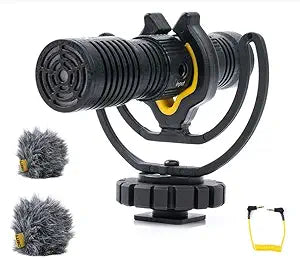
Aputure AP-V-MICD4DUO Deity V-Mic D4 DUO On-Camera Microphone
50Hz-20KHz
Capture interviewer and subject on a single camera rig — the D4 DUO's dual cardioid design solves the two-person audio problem without a second recorder.
$59.99*
View on Amazon
✓ In Stock on Amazon.com
*Price sourced from Amazon.com. Last updated:Sep 05, 2026.Price and availability are subject to change — details.
Affiliate Disclosure: As an Amazon Associate, Studio Supplies earns from qualifying purchases made through links on this page, at no additional cost to you. This helps support our editorial team.
Notice a mistake? Let Us Know
Overview
Key Features
SUPERIOR SOUND - Dual cardioid capsules capture crisp, clear audio from both front and rear, perfect for interviews and vlogging, ensuring professional-grade recordings.
REDUCE UNWANTED NOISE - The included Rycote LYRE shockmount minimizes vibrations and handling noise, delivering clean sound even in dynamic shooting environments.
BUILT TO LAST - Crafted from durable aluminum, the V-Mic D4 DUO withstands rigorous use, ensuring reliability for on-location shoots and long-term performance.
VERSATILE CONNECTIVITY - Features a 3.5mm TRS output and AUX input, compatible with cameras and devices, offering seamless integration into your existing setup.
PRECISION AUDIO CAPTURE - With a frequency range of 50Hz-20KHz and high sensitivity, this microphone accurately reproduces sound, enhancing your audio quality.
Specifications
Pickup Pattern
Dual Cardioid (front + rear)
Frequency Response
50Hz – 20kHz
Microphone Type
Passive (external bias voltage)
Output Connector
3.5mm TRS
AUX Input
3.5mm TRS
Shockmount
Rycote LYRE
Mounting Thread
1/4" and 3/8"
Body Material
Aluminum
Model
AP-V-MICD4DUO
Frequently Asked Questions
How does the dual cardioid configuration actually work, and what are the gain staging implications?
The D4 DUO houses two separate cardioid capsules — one forward-facing and one rear-facing. Both capsules share a single 3.5mm TRS output, which means you get a summed mono output carrying audio from both directions, not a dual-channel stereo output. For interview work, this means both voices land on the same track — gain staging for the camera's input should be set to accommodate the louder of the two sources to avoid clipping on the front-facing channel.
Does the D4 DUO require phantom power or batteries?
No. The D4 DUO is a passive microphone that runs on external bias voltage supplied by the camera's 3.5mm mic input (plug-in power). It does not accept 48V phantom power and does not require any batteries or external power source. Most mirrorless and DSLR cameras provide the required bias voltage by default.
What does the AUX input do, and can I use it to feed a wireless receiver?
Yes — the AUX TRS 3.5mm input is designed specifically to accept a lavalier microphone or the output of a wireless receiver. When a source is plugged into the AUX input, it mixes with the microphone's own capsule output and passes the combined signal to the camera. This allows a single camera channel to carry both on-camera ambient audio and a talent lav or wireless feed simultaneously.
How effective is the Rycote LYRE shockmount at isolating camera handling noise?
The Rycote LYRE suspension is well-established as one of the better passive isolation systems available in on-camera mounting — it decouples the microphone body from the cold shoe mount mechanically rather than relying on rubber grommets that degrade over time. Under normal handheld camera movement, it performs well. In situations with heavy camera tapping, stair climbing, or mounted on a gimbal, low-frequency rumble can still bleed through — pairing with a deadcat windscreen helps reduce wind and motion artifacts in those conditions.
What is the frequency response range and how does it handle high-frequency transients like consonants in dialogue?
The D4 DUO's specified frequency range is 50Hz–20kHz. The cardioid capsule design captures consonant transients cleanly across the vocal range — sibilance is present but not exaggerated at typical interview distances of 1–2 feet. For subjects positioned further from the rear capsule (beyond 3–4 feet), high-frequency detail will roll off naturally due to distance and off-axis capsule response.
Related Products


