



Behringer
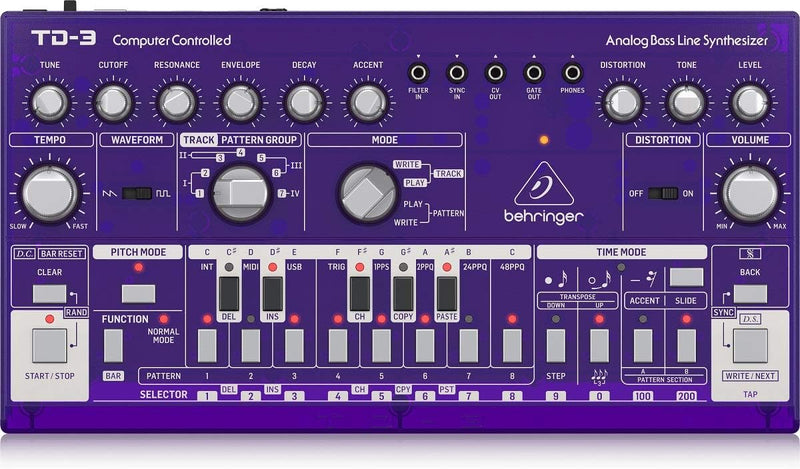
Behringer 000-EDU04-00010 TD-3-GP Analog Bass Synthesizer
The Behringer TD-3-GP brings the raw, filter-driven growl of classic analog bass synthesis back to life at a price that puts it on every producer's desk.
$149.00*
Check availability
*Price sourced from Amazon.com. Last updated:Aug 29, 2026.Price and availability are subject to change — details.
Affiliate Disclosure: As an Amazon Associate, Studio Supplies earns from qualifying purchases made through links on this page, at no additional cost to you. This helps support our editorial team.
Notice a mistake? Let Us Know
Overview
Key Features
Amazing Bass Line synthesizer with true analog circuitry for bass and groove sounds
Authentic reproduction of original circuitry with matched transistors
Pure analog signal path based on legendary VCO, VCF and VCA designs
Sawtooth and square waveform VCO with transistor wave-shaping circuitry
Amazing 4-pole low-pass resonant filter with cut-off, resonance, envelope, decay and accent controls
Specifications
Type
Analog Bass Line Synthesizer
Circuitry
True analog VCO, VCF, VCA
VCO Waveforms
Sawtooth, Square
Filter Type
4-pole low-pass resonant
Filter Controls
Cut-off, Resonance, Envelope, Decay, Accent
Sequencer
16-step
Poly Chain
Up to 16 voices (multiple units)
Effects
Distortion
Connectivity
USB, MIDI DIN
Brand
Behringer
Model
TD-3-GP
Frequently Asked Questions
How close does the TD-3-GP's filter actually sound to the original circuit it's based on?
Very close for the money. Behringer used matched transistors in the VCF to replicate the ladder filter character — the resonant cutoff sweep has that liquid, self-oscillating quality that defines the genre. It won't fool a trained ear side-by-side with an original, but it captures the essential sonic DNA in a way that holds up in a mix.
Does the TD-3-GP's sequencer have any timing limitations I should know about for live use?
The 16-step sequencer is fixed-length with no real-time step addition. It's modeled on the original pattern-based workflow, so if you're used to piano-roll sequencing in a DAW, there's a programming learning curve. It sends and receives MIDI clock, which keeps it tightly synced to a host or hardware setup.
Can the TD-3-GP be used as a MIDI-controlled synth without using its onboard sequencer?
Yes — via USB MIDI or the standard MIDI DIN connection, you can trigger notes from a DAW or keyboard controller and use the sequencer bypass. This makes it practical as a dedicated bass voice in a larger rack or studio rig.
What does the Poly Chain feature actually do in practice?
Poly Chain links multiple TD-3 units together to create up to 16-voice polyphony. Since each unit is monophonic by design, chaining is the only way to play chords. For most bass synthesis applications a single voice is all you need, but it's a useful feature for pad textures.
Does the TD-3-GP include a distortion effect, and how usable is it?
Yes, an onboard overdrive/distortion circuit is included. It adds harmonic saturation that thickens the already resonant filter output — useful for going from clean acid bass to aggressive industrial textures without an external pedal.
Related Products


