



Behringer
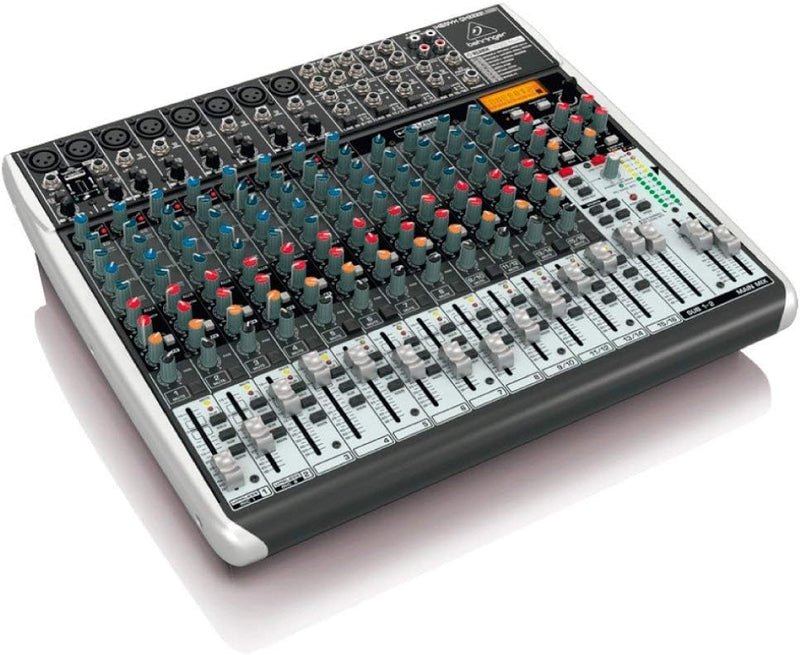
Behringer Xenyx QX2222USB 22-Input Mixer USB Effects
Eight XENYX preamps, onboard compression, and USB I/O in one mixer — built for the working live or studio engineer on a budget.
$358.30*
View on Amazon
✓ In Stock on Amazon.com
*Price sourced from Amazon.com. Last updated:Oct 21, 2026.Price and availability are subject to change — details.
Affiliate Disclosure: As an Amazon Associate, Studio Supplies earns from qualifying purchases made through links on this page, at no additional cost to you. This helps support our editorial team.
Notice a mistake? Let Us Know
Overview
Key Features
2/2-bus mixer with 60mm faders
USB Audio Interface
Onboard Effects
3-band EQ
22-input
Specifications
Total Inputs
22
Mic Preamps
8 XENYX, phantom-powered
Compressors
8 one-knob studio-grade
FX Processor
KLARK TEKNIK, 32 presets
EQ
Neo-classic British 3-band, semi-parametric mid
Aux Sends
3 per channel
USB Interface
Built-in stereo USB/audio interface
Faders
60mm logarithmic-taper
Bus Configuration
2/2-bus
Power Supply
Switching, 100–240V~
Frequently Asked Questions
How do the XENYX mic preamps perform at high gain settings — is self-noise an issue for quiet sources like acoustic instruments or voiceover?
The XENYX preamps have a reasonably low noise floor for the price class, but at high gain settings (above 50dB), you will hear a noise floor rise that can be problematic for very quiet sources like a delicate acoustic guitar or a soft-spoken voiceover talent. For louder sources — live vocals, guitar amps, drums — gain staging is not a concern in normal use.
Does the QX2222USB require a dedicated driver for USB recording, or is it class-compliant?
The USB audio interface is class-compliant on macOS and works with core audio without driver installation. Windows users will want to download the ASIO driver from Behringer for low-latency DAW recording performance.
Does this mixer supply 48V phantom power to all eight mic preamp channels?
Yes — all eight microphone inputs are phantom-powered, so condenser microphones can be used across the full microphone channel count without an external phantom power supply.
What does the "one-knob" compressor actually control, and is it useful for live work?
Each compressor is a single-knob design that sweeps from no compression to heavy limiting — Behringer sets a fixed ratio and attack/release curve internally. It is a time-saving tool for live vocals and instruments where transparent gain reduction is more useful than surgical control.
Can the KLARK TEKNIK effects processor run simultaneously with the USB interface during a live-to-DAW recording session?
Yes — the FX processor, USB interface, and analog outputs operate independently. You can send reverb-treated signal to the PA via the main outs while recording a dry or wet mix to a DAW over USB at the same time, depending on your routing.
Related Products


