



Behringer
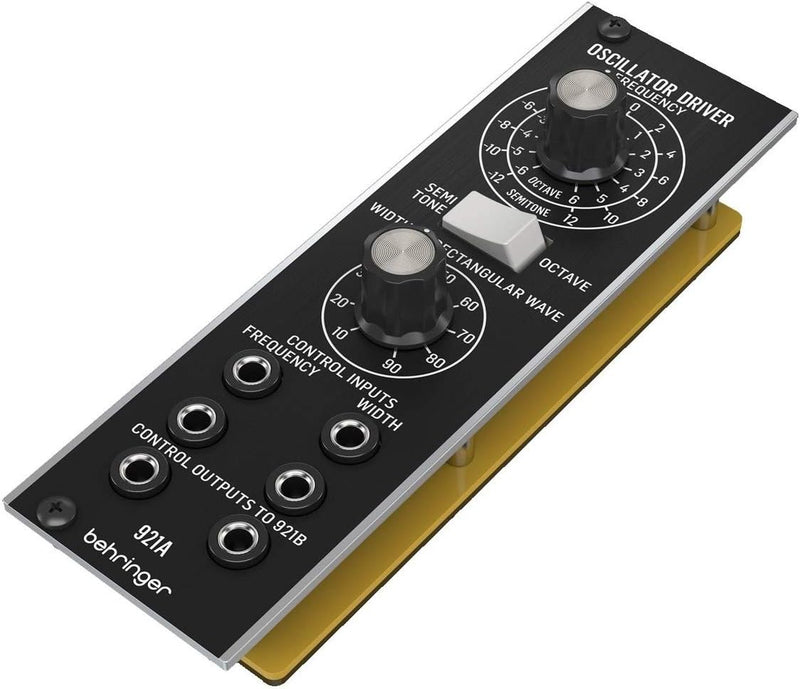
Behringer 921A OSCILLATOR DRIVER Eurorack Module
Drive up to 12 parallel 921B oscillators from a single voltage source and unlock the full tonal complexity of a classic Moog-style modular voice.
$29.90*
View on Amazon
✓ In Stock on Amazon.com
*Price sourced from Amazon.com. Last updated:Oct 21, 2026.Price and availability are subject to change — details.
Affiliate Disclosure: As an Amazon Associate, Studio Supplies earns from qualifying purchases made through links on this page, at no additional cost to you. This helps support our editorial team.
Notice a mistake? Let Us Know
Overview
Key Features
Controls up to 12 parallel 921B OSCILLATOR modules
Authentic reproduction of the circuitry from the “Modular 55 & 35” Series
Artist roster includes world’s most famous pop, rock and jazz musicians
2 summed CV inputs for frequency control and 2 summed CV inputs for PWM
High current outputs for frequency and pulse width to drive multiple 921B modules
Specifications
Brand
Behringer
Model
921A Oscillator Driver
Max Oscillators Driven
12 parallel 921B modules
CV Inputs (Frequency)
2 summed
CV Inputs (PWM)
2 summed
Output Type
High current (frequency and pulse width)
Connectors
1/8" (3.5mm) TS jacks
Format
Eurorack
Power
DC via Eurorack power header
Frequently Asked Questions
What does the 921A actually do in a modular patch, and why is it separate from the 921B?
The 921A is a driver module, not a sound-generating oscillator. It takes CV pitch and PWM signals as inputs, buffers and amplifies them to high-current outputs, and distributes those signals to up to 12 921B oscillator modules simultaneously. This mirrors the original Moog 921A/921B architecture, where a single driver coordinates a bank of oscillators for massive unison or detuned ensemble sounds — something a single oscillator or standard mult cannot achieve cleanly.
How many CV inputs does the 921A provide, and can I use multiple sources simultaneously?
The 921A provides 2 summed CV inputs for frequency control and 2 summed CV inputs for pulse width modulation. Summed inputs mean both signals are mixed together, so you can layer an LFO over a keyboard CV without a separate mixer — a significant patching convenience in a live or complex studio setup.
Will the 921A work with any Eurorack 921B modules, or only Behringer's?
The 921A is designed to drive Behringer's 921B oscillator modules, which are authentic reproductions of the Moog 921B. It is engineered for that specific voltage and current specification. Compatibility with third-party 921B clones or other Eurorack oscillators is not guaranteed and depends on the receiving module's CV input impedance and voltage tolerance.
What power does the 921A require, and what are the Eurorack power specs?
The 921A requires DC power supplied via standard Eurorack power header. Exact current draw specs should be confirmed in the module's technical datasheet before placing it in a case with limited headroom — high-current output modules can draw more than a typical oscillator.
Is the 921A useful as a standalone module without multiple 921B oscillators?
Its utility is limited without at least one 921B. The module is purpose-built as a driver and distributor — its value scales directly with the number of 921B oscillators it's feeding. With a single 921B, a standard CV connection achieves the same result without the overhead of the driver stage.
Related Products


