



Behringer
Behringer DUAL ENVELOPE GENERATOR MODULE 1003 Eurorack Module
Authentic '70s dual ADSR circuitry brings classic 2500 Series envelope shaping to your modern Eurorack system.
$39.00*
Check availability
*Price sourced from Amazon.com. Last updated:Aug 29, 2026.Price and availability are subject to change — details.
Affiliate Disclosure: As an Amazon Associate, Studio Supplies earns from qualifying purchases made through links on this page, at no additional cost to you. This helps support our editorial team.
Notice a mistake? Let Us Know
Overview
Key Features
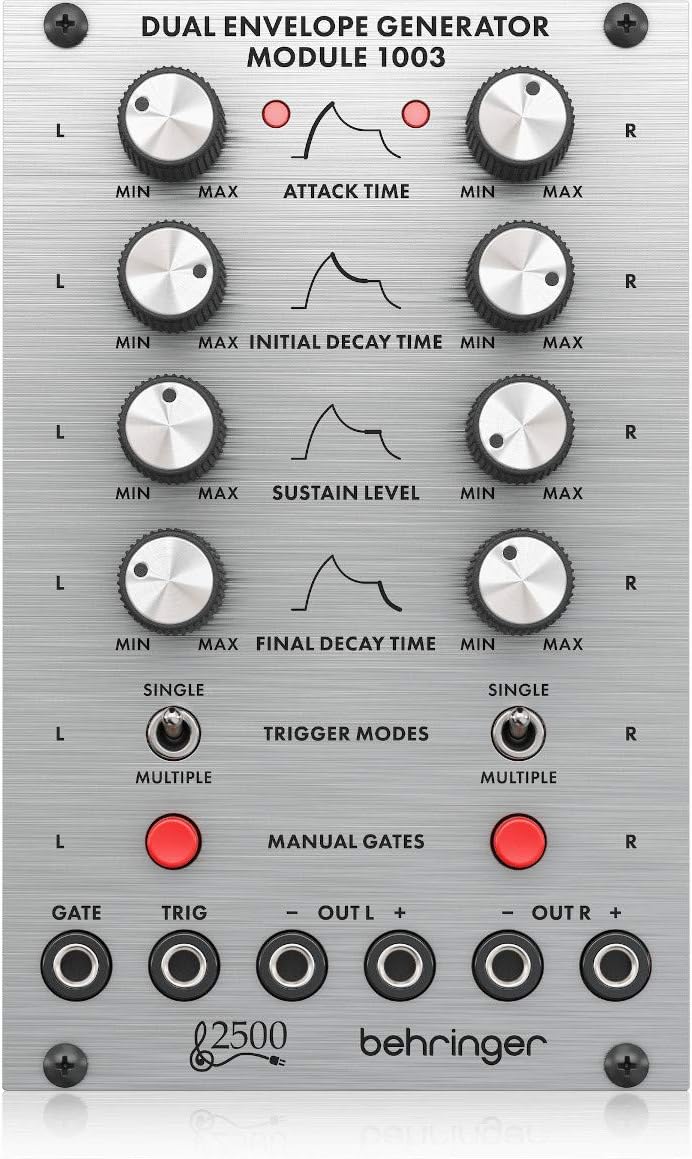
Classic 1003 dual analog ADSR generator module from the '70s
Authentic reproduction of the circuitry from the "2500" Series
Contains 2 identical envelope generators for creating control signals
4 adjustable parameters: Attack, initial Decay, Sustain, final Decay
Each envelope is initiated by Gate and Trigger signals
Specifications
Brand
Behringer
Model
DUAL ENVELOPE GENERATOR MODULE 1003
Series
2500 Series
Type
Dual Analog ADSR Envelope Generator
Number of Envelopes
2 (identical, independent)
Parameters
Attack, initial Decay, Sustain, final Decay
Inputs
Gate, Trigger (per envelope)
Connector Type
3.5 mm TS jack
Format
Eurorack
Frequently Asked Questions
How does the 1003's ADSR implementation differ from a standard four-stage envelope?
The 1003 follows the original 2500 Series architecture, which uses Attack, initial Decay, Sustain, and final Decay rather than the more common Attack-Decay-Sustain-Release layout. That final Decay stage shapes the release tail differently from a standard ADSR — you hear it as a more organic, vintage envelope character that modern digital envelopes often can't replicate convincingly.
Can both envelopes run independently on separate voices or modulation targets?
Yes — the two envelope generators are identical and fully independent, each with its own Gate and Trigger inputs. You can route them to separate VCAs, VCFs, or modulation destinations in the same patch without any interaction between them.
What Eurorack rack space does this module occupy?
Connector format is 3.5 mm TS jack, standard Eurorack spec. HP width is not listed in the specs — confirm panel size against your case before purchasing.
Does this module require a specific Eurorack power supply voltage?
The 1003 is designed for standard Eurorack power headers. Consult the module's power draw specs before installation to confirm compatibility with your bus board's current capacity, particularly in densely populated cases.
Is the 1003 suitable for percussive envelope work as well as sustained pads?
The adjustable Attack and dual-Decay parameters give you very short, snappy transients for percussive triggering as well as slow, evolving shapes for pad modulation. The initial Decay stage is particularly useful for tightening up plucked or struck patch textures.
Related Products


