



Behringer
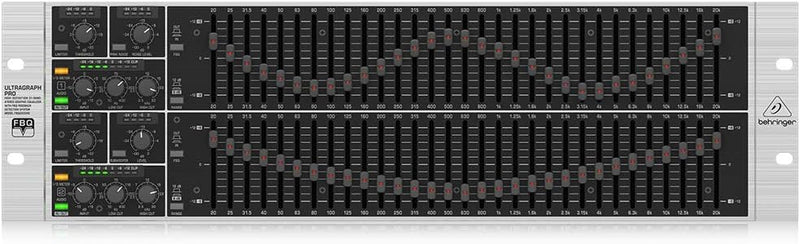
Behringer FBQ6200HD ULTRAGRAPH PRO 31-Band Stereo Equalizer
Precision 31-band EQ with live feedback detection that keeps your mix clean and your signal chain honest.
$169.00*
Check availability
*Price sourced from Amazon.com. Last updated:Oct 21, 2026.Price and availability are subject to change — details.
Affiliate Disclosure: As an Amazon Associate, Studio Supplies earns from qualifying purchases made through links on this page, at no additional cost to you. This helps support our editorial team.
Notice a mistake? Let Us Know
Overview
Key Features
Audiophile 31-band stereo graphic equalizer for live and studio applications
Revolutionary FBQ Feedback Detection system instantly reveals critical frequencies and can also be used as audio analyzer
Ultra-low noise 4580 operational amplifiers for highest signal integrity
Dedicated Limiters with gain reduction meters for each channel protect your sound system from overload and distortion
Pink noise generator provides test signals to adapt your sound system to any room acoustics
Specifications
Type
31-Band Stereo Graphic Equalizer
Channels
2 (Stereo)
Bands per Channel
31
Operational Amplifiers
Ultra-low noise NJM4580
Feedback Detection
FBQ Feedback Detection System
Limiters
Dedicated per-channel limiters with gain reduction meters
Test Signal
Pink Noise Generator
Application
Live sound, studio
Frequently Asked Questions
What is the FBQ Feedback Detection system and how does it work in a live setting?
The FBQ system continuously monitors the audio signal across all 31 bands and illuminates LEDs on the offending frequency sliders the moment feedback begins to build — before it rings out. This lets you pull down the problem frequency surgically in real time, rather than sweeping blindly or relying on memory.
Does the FBQ6200HD require phantom power, and how does it integrate into a typical FOH signal chain?
No phantom power is required — this is a line-level device, not a microphone. It inserts post-console, pre-amplifier: the console's main or monitor output feeds into the EQ's balanced XLR or TRS inputs, and the EQ outputs drive your power amplifiers or powered speakers. Standard -10 dBV or +4 dBu operation.
How does the pink noise generator help with room tuning?
The built-in pink noise generator outputs a broadband test signal directly through the EQ's signal path. You feed that signal through your system and use a measurement mic or SPL meter at the listening position to identify room resonances, then notch those frequencies on the EQ sliders. It eliminates the need for a separate signal generator during setup.
Are the dedicated limiters per-channel, and what do the gain reduction meters actually tell you?
Yes — each stereo channel has its own independent limiter with a corresponding gain reduction meter on the front panel. When the meter shows activity, your signal has hit the limiter threshold. This is your warning to either reduce input gain from the console or lower output trim, protecting downstream amplifiers from clipping transients.
What is the noise performance of the 4580 op-amps in practice?
The NJM4580 operational amplifiers are specified for low noise and low distortion at line-level signal levels. In practice, at unity gain with all sliders flat, the FBQ6200HD introduces minimal coloration — the noise floor is low enough that it won't be audible above the ambient noise in most live venues. At maximum boost settings, some additional noise is introduced, as with any active EQ.
Related Products


