



Behringer
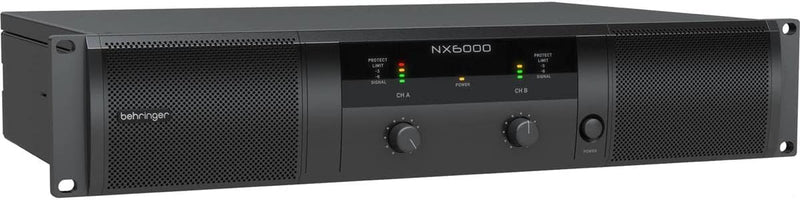
Behringer NX6000 6000-Watt Class-D Power Amplifier
13 lbs
Massive headroom and near-zero thermal buildup make the NX6000 the workhorse power amp that keeps your FOH signal chain honest at 6000 watts.
$449.00*$607.59Save 26%
View on Amazon
✓ In Stock on Amazon.com
*Price sourced from Amazon.com. Last updated:Oct 21, 2026.Price and availability are subject to change — details.
Affiliate Disclosure: As an Amazon Associate, Studio Supplies earns from qualifying purchases made through links on this page, at no additional cost to you. This helps support our editorial team.
Notice a mistake? Let Us Know
Overview
Key Features
Delivers 2 x 3000 watts into 4 ohms; 2 x 1600 watts into 8 ohms and weighs less than 13 lbs/ 5.9 kg
Ultimate reliability through revolutionary cool-running high-density Class-D technology with "near-zero" Thermal buildup
Ultra-efficient switch-mode power supply for noise-free audio, superior transient response and low power consumption
Built-in stereo crossover with low-cut, high-cut and full range Mode
Smartsense loudspeaker Impedance compensation features fully Linear frequency response at any speaker load Impedance
Specifications
Output Power (4 Ohms)
2 x 3000W
Output Power (8 Ohms)
2 x 1600W
Peak Power
3,000W peak/ch at 4 ohms
Channels
2-channel
Amplifier Class
Class-D
Power Supply
Switch-mode
Weight
Less than 13 lbs / 5.9 kg
Speaker Connectors
Twist-lock
Crossover
Built-in stereo (low-cut, high-cut, full-range)
Protection
Thermal overload protection
Impedance Compensation
SmartSense loudspeaker impedance compensation
Frequently Asked Questions
How does the NX6000's Class-D topology affect the sound compared to traditional Class-AB amplifiers?
Class-D in the NX6000 uses a switching power supply that maintains a consistently stable rail voltage, which translates to tighter, more controlled low-frequency transient response — kick drums and bass lines hit with authority rather than blooming. The trade-off historically associated with Class-D (high-frequency harshness) is well-managed here; the output stays clean and linear across the audio band under real load conditions.
What impedance loads does the NX6000 handle, and how does that affect my speaker setup?
The NX6000 delivers 2 x 3000W into 4 ohms and 2 x 1600W into 8 ohms per channel. In practice, running 4-ohm cabinets gives you the full rated headroom — essential for high-SPL live applications. The SmartSense impedance compensation ensures the frequency response stays linear regardless of which load you're driving, so your tone doesn't shift when you swap cabinets.
Does the Class-D topology color the signal or introduce audible artifacts at high output levels?
Class-D designs have historically raised concerns about transient smearing, but the NX6000's switch-mode power supply addresses this with what Behringer describes as superior transient response. At typical live sound levels, the amp stays transparent — what you send in is what the speakers reproduce. Artifacts become more apparent only when the amp is pushed into thermal limiting, which the near-zero thermal buildup design is specifically engineered to delay.
What impedance loads does the NX6000 support, and how does that affect system design?
The NX6000 delivers 2×3000W into 4 ohms and 2×1600W into 8 ohms per channel. The SmartSense impedance compensation actively adjusts frequency response as speaker load varies, so you won't hear the top-end rolloff or bass bloat that typically occurs when driving mismatched cabinets. This makes it practical for mixed-impedance line arrays without adding a crossover network.
Does the NX6000 require rack ventilation allowances given its power output?
Unlike traditional amplifiers at this wattage class, the NX6000 runs remarkably cool due to its high-efficiency Class-D design — most of the draw becomes audio output rather than heat. Standard 1U of rack breathing room is generally sufficient, but avoid sealing it in a dead-air enclosure during extended high-SPL shows.
How does the built-in crossover integrate into a live or install workflow?
The onboard stereo crossover offers low-cut, high-cut, and full-range modes, letting you use the NX6000 in a bi-amp configuration without an external processor. For a two-way system, this simplifies your rack and reduces the signal path — fewer boxes, fewer conversion stages, lower noise floor at the output.
What connectivity does the NX6000 offer for professional installs and touring rigs?
Speaker outputs use Twist-lock connectors, which are a touring-grade choice — they won't vibrate loose mid-show. Input connectivity is standard for pro-audio rack gear. The unit is a 2-channel amp, so a stereo or dual-mono configuration is straightforward without any patching gymnastics.
What does the built-in crossover offer for live system configuration?
The NX6000 includes a stereo crossover with low-cut, high-cut, and full-range modes. This lets you configure biamped systems — subs on one channel, tops on the other — directly from the amplifier without an external processor, which simplifies your drive rack and reduces signal chain noise floor.
Is the NX6000 suitable for touring or is it designed primarily for installed systems?
At under 13 lbs, the NX6000 is genuinely portable for a 6000-watt amplifier, making it viable for touring applications where weight and rack space are at a premium. The robust thermal protection and switch-mode PSU handle voltage fluctuations common on venue power — a real-world durability point worth noting.
Is the NX6000 suitable for fixed installs as well as touring?
Yes. The sub-13 lb weight makes it unusually portable for a 6000-watt amplifier, which benefits touring rigs where rack weight accumulates fast. For fixed installs, the thermal efficiency means you're not engineering elaborate ventilation into the rack — the amp runs cool enough to co-exist with heat-sensitive processing gear.
Related Products


