Behringer

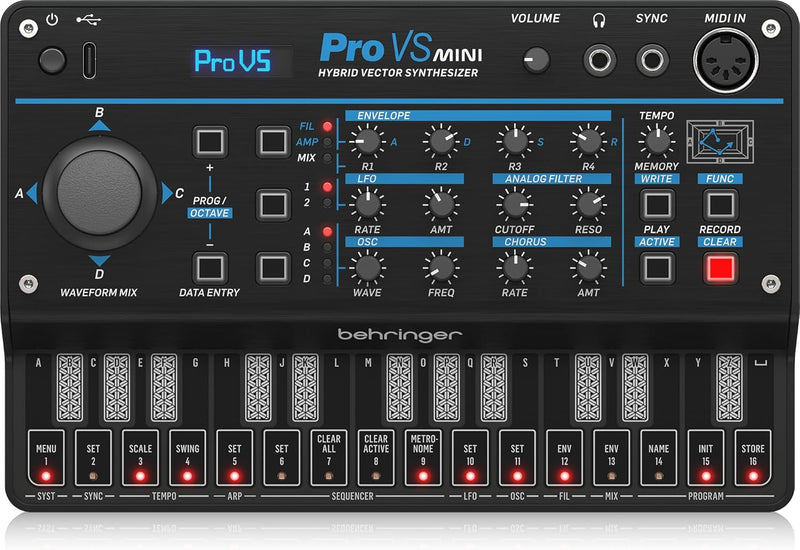
Behringer PRO-VS MINI Hybrid Vector Synthesizer

5.0 (9 reviews)

Behringer's Prophet VS resurrection brings 128-waveform vector morphing and analog filter warmth to a bus-powered desktop synth for under $200.

$119.00*
Check availability

*Price sourced from Amazon.com. Last updated:Jun 28, 2026.Price and availability are subject to change.

Affiliate Disclosure: Studio Supplies may earn a commission from qualifying purchases made through links on this page, at no additional cost to you. This helps support our editorial team.

Notice a mistake? Let Us Know

Overview

The Behringer PRO-VS MINI is a compact hybrid vector synthesizer that reconstructs the synthesis engine of the Sequential Circuits Prophet VS — a mid-1980s instrument whose wave table oscillators and joystick-controlled vector mixing influenced a generation of electronic music production. The engine houses 128 waveforms drawn from that lineage, routed through an analog glow pass filter, giving you the harmonic complexity of digital wave tables with the resonant character of analog filtering. Four-voice polyphony keeps the architecture lean, but it's a meaningful trade-off for the form factor and price. The joystick-controlled blend between four simultaneous oscillator waveforms is the instrument's defining capability — it creates timbral movement that evolves over time in ways that LFO-modulated subtractive synthesis simply doesn't replicate.

For studio sound designers and electronic producers who want textural synthesis beyond standard wavetable plugins, the PRO-VS MINI offers a tactile, hands-on workflow. The 16-step sequencer with three pattern slots enables generative rhythmic and melodic sketching, while the independent envelopes for Filter, Amp, and OSC Mix give you surgical control over how the vector blend evolves across a note's life cycle. Bus-powered via USB-C, it fits into a laptop production setup without a power brick — genuinely useful for location work and studio sketching. The 27-key touch-sensitive keyboard spans just over two octaves, which suits melodic lead and bass work but will feel constrained for pianists. At this price point, the PRO-VS MINI is among the most architecturally interesting synthesizers available — the vector morphing character is not available anywhere else at this cost.

Key Features

This vector synthesizer has faithfully reproduced the sound engine of the "Prophet VS*" synthesizer, with 128 waveforms and wave table synthesis

27 touch-sensitive keyboard with excellent playability and joystick that intuitive 4 waveform morphing

Simple 16-step sequencer with 3 patterns to choose from

Built-in studio grade chorus effects and independent envelope for Filter/Amp/OSC Mix

USB Type-C port that can be powered by a mobile battery or computer. Note: USB Type-C cable for power is not included. Please use your USB Type-C cable or purchase it separately

Specifications

Brand
Behringer
Model
PRO-VS MINI
Synthesis Type
Hybrid Vector Synthesis
Waveforms
128
Polyphony
4 voices
Keyboard
27 keys, touch-sensitive
Sequencer
16-step, 3 patterns
Effects
Built-in studio-grade chorus
Envelopes
Independent for Filter, Amp, OSC Mix
Power
USB Type-C (cable not included)

Pros & Cons

👍 Pros

  • 128 waveforms with vector joystick morphing produce continuously evolving timbres that are genuinely difficult to achieve through any other synthesis method.
  • Analog glow pass filter adds organic warmth and resonance to the digital oscillator stack — the hybrid architecture sounds more complex than either element alone.
  • USB-C bus power means the PRO-VS MINI runs off a laptop or mobile battery without a dedicated power supply, making it legitimately portable for studio sketching.
  • Built-in studio-grade chorus effect adds dimension and width without requiring an external effects unit in the signal chain.
  • Independent envelopes for Filter, Amp, and OSC Mix give the vector synthesis engine meaningful expressive control beyond simple attack/decay.

👎 Cons

  • 4-voice polyphony is a hard architectural limit — lush pad voicings and extended jazz chords will hit note stealing in real playing conditions.
  • The 27-key mini keyboard range constrains playability for pianists accustomed to full-size keys and a wider octave span.
  • USB-C cable for power is not included in the box — an omission that interrupts the "plug in and play" experience and requires a separate purchase.
  • MIDI clock sync and full MIDI implementation details are not clearly documented, creating uncertainty for users planning tight DAW or hardware integration.
  • 3 pattern slots in the sequencer is a minimal arrangement — live performance that requires more than three distinct sequences will hit a workflow ceiling quickly.

Frequently Asked Questions

Vector synthesis uses a joystick to blend between four independent oscillator waveforms in real time, creating dynamic timbral movement that subtractive synthesis can't replicate with static oscillator mixing. The PRO-VS MINI's 128 waveforms include the wave table content of the original Prophet VS, so you're getting digital wavetable oscillators routed through an analog-style glow pass filter — the digital top end with analog warmth underneath.
The PRO-VS MINI has its own audio output — it does not require an audio interface to produce sound. However, for recording into a DAW, you'll route its output through an interface's line input. The USB-C port handles power only, not audio.
MIDI clock sync capability is not confirmed in the available specifications. The PRO-VS MINI has a 16-step sequencer with 3 pattern slots, but buyers needing tight DAW-synchronized sequencing should verify MIDI implementation details with Behringer before purchase.
The PRO-VS MINI is 4-voice polyphonic. For dense chordal pad work, four voices is a practical ceiling — stacking extended chords will result in note stealing. For lead lines, bass, and two-to-three note voicings, four voices is sufficient.
The keyboard is described as touch-sensitive. Whether this translates to full velocity sensitivity for MIDI output should be confirmed with Behringer's MIDI implementation chart, as "touch-sensitive" on budget instruments sometimes refers to aftertouch or a simplified velocity response rather than full 127-step velocity.