

Price history
Behringer
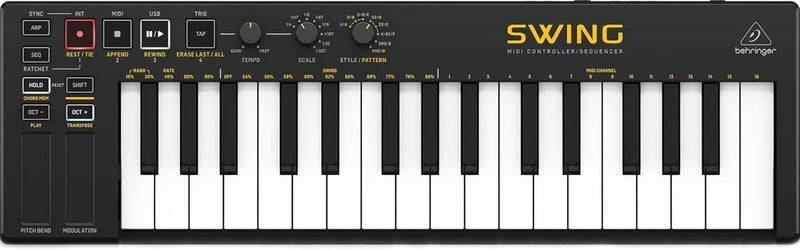
Behringer SWING 32-Key USB MIDI Keyboard Controller
★★★★★
Compose and Control with the Behringer Swing Keyboard Controller The Behringer Swing is a versatile 32-key USB MIDI keyboard controller designed for music production and performance. Featuring a built-in sequencer, chord and arpeggiator modes, and various connectivity options, the Swing provides ...
$119.00*
View on Amazon
✓ In Stock on Amazon.com
*Price sourced from Amazon.com. Last updated:Jul 23, 2026.Price and availability are subject to change.
Affiliate Disclosure: Studio Supplies may earn a commission from qualifying purchases made through links on this page, at no additional cost to you. This helps support our editorial team.
Notice a mistake? Let Us Know
Overview
Compose and Control with the Behringer Swing Keyboard Controller
The Behringer Swing is a versatile 32-key USB MIDI keyboard controller designed for music production and performance. Featuring a built-in sequencer, chord and arpeggiator modes, and various connectivity options, the Swing provides a comprehensive solution for creating and controlling your music.
Specifications:
- Keys: 32 Keys
- Sequencer: 64-Step Polyphonic Sequencer
- Modes: Chord and Arpeggiator Modes
- MIDI I/O: 5-pin DIN MIDI I/O
- Sync I/O: 3.5mm TRS Sync I/O
- Sustain Input: 1/4" TS Sustain In
Key Features
32 compact-sized keys for expressive velocity and after-touch functionality
64-step sequencer featuring 8-note polyphony with rest, tie and legato note entry
Chord Play mode with up to 16 notes for extensive loops and long-playing samples
Arpeggiator mode with 8 simultaneous notes per step and 8 styles
Highly reactive pitch and modulation touch strips for extreme performance and creativity
Specifications
Key Count
32
Key Type
Compact-sized, velocity-sensitive with after-touch
Sequencer Steps
64
Sequencer Polyphony
8-note
Chord Play Mode Notes
Up to 16
Arpeggiator Notes per Step
8 simultaneous
Arpeggiator Styles
8
Performance Controls
Pitch and modulation touch strips
Connectivity
USB MIDI
Frequently Asked Questions
What kind of keys does the Behringer SWING have?
The Behringer SWING features 32 compact-sized keys that offer expressive velocity and after-touch functionality for nuanced playing.
How powerful is the sequencer on this MIDI controller?
It includes a 64-step sequencer with 8-note polyphony, allowing for complex musical patterns and precise note entry with rest, tie, and legato functions.
What is the Chord Play mode feature?
The Chord Play mode allows you to create extensive loops and long-playing samples with up to 16 notes, enhancing your compositional capabilities.
What does the Arpeggiator mode offer?
The Arpeggiator mode provides versatility with 8 simultaneous notes per step and 8 different styles, enabling dynamic and creative melodic phrases.
How does the Behringer SWING enhance performance and creativity?
It is equipped with highly reactive pitch and modulation touch strips, designed to offer extreme control and expressiveness during live performance or recording.
Is this a standalone instrument or does it require other equipment?
As a USB MIDI Keyboard Controller, the Behringer SWING requires connection to a computer or other MIDI-compatible devices to control software or hardware instruments for sound production.
Related Products


