

Behringer
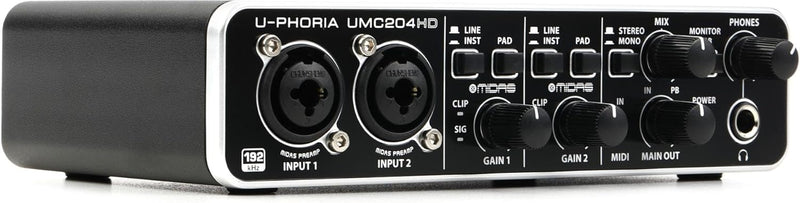
Behringer UMC204HD U-Phoria USB Audio Interface
USB 2.0Phantom Power
Pro-Quality Audio Interface for Musicians and ProducersThe Behringer U-Phoria UMC204HD is a 2x4 USB Audio/MIDI Interface delivering pristine 24-Bit/192 kHz resolution and MIDAS mic preamps, ideal for professional recording and monitoring. Resolution: 24-Bit/192 kHz for professional audio quality...
$109.00*$119.00Save 8%
Check availability
*Price sourced from Amazon.com. Last updated:Oct 21, 2026.Price and availability are subject to change — details.
Affiliate Disclosure: As an Amazon Associate, Studio Supplies earns from qualifying purchases made through links on this page, at no additional cost to you. This helps support our editorial team.
Notice a mistake? Let Us Know
Overview
Pro-Quality Audio Interface for Musicians and Producers
The Behringer U-Phoria UMC204HD is a 2x4 USB Audio/MIDI Interface delivering pristine 24-Bit/192 kHz resolution and MIDAS mic preamps, ideal for professional recording and monitoring.
- Resolution: 24-Bit/192 kHz for professional audio quality.
- Preamps: 2 MIDAS Preamps
- Phantom Power: Included for condenser microphones.
- MIDI I/O: For connecting MIDI devices.
- Inserts: For external effects processing.
Key Features
2-in/4-out USB 2.0 Audio Interface with 2 MIDAS Preamps
24-bit/192kHz
Phantom Power
MIDI I/O
Inserts
Specifications
Product Type
USB Audio Interface
Input/Output Channels
2-in/4-out
USB Version
2.0
Audio Resolution
24-bit/192kHz
Preamps
2 x MIDAS Preamps
Power Feature
Phantom Power
MIDI Connectivity
MIDI I/O
Analog Connectivity
Inserts
Frequently Asked Questions
How many inputs and outputs does the Behringer UMC204HD have?
The Behringer UMC204HD is a 2-in/4-out USB 2.0 Audio Interface, providing two inputs for recording and four outputs for monitoring or routing audio.
What is the maximum audio resolution supported by this interface?
This audio interface supports a high resolution of 24-bit/192kHz, which is suitable for professional-grade audio recording and playback.
Does the UMC204HD provide phantom power for microphones?
Yes, the Behringer UMC204HD includes phantom power, allowing you to use condenser microphones that require this feature for operation.
Can I connect MIDI devices to this audio interface?
Yes, the UMC204HD features MIDI I/O (Input/Output), enabling connectivity with MIDI keyboards, controllers, and other MIDI-compatible devices.
What are the "Inserts" feature on this interface used for?
The "Inserts" on the Behringer UMC204HD allow you to patch in external effects processors, such as compressors or EQs, directly into the signal path of the inputs before conversion.
Related Products


