



B+W
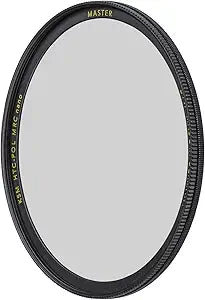
B+W 1101627: 52mm Master HTC Kaesemann C-POL Filter
★★★★★
Pull saturated skies and reflection-free water from every frame — the B+W 52mm Master HTC Kaesemann CPL is the polarizer serious landscape photographers trust.
$98.83*
View on Amazon
✓ In Stock on Amazon.com
*Price sourced from Amazon.com. Last updated:Jul 14, 2026.Price and availability are subject to change.
Affiliate Disclosure: Studio Supplies may earn a commission from qualifying purchases made through links on this page, at no additional cost to you. This helps support our editorial team.
Notice a mistake? Let Us Know
Overview
Key Features
Black Knurled Thin Profile Filter Mount for Better Grip
MRC Coating to Control Flare & Ghosting
New QR Code included to Verify Authenticity
Good for down to 17mm Full Frame Format
ECO-Friendly Packaging
Specifications
Filter Size
52mm
Filter Type
Circular Polarizer (CPL)
Construction
Kaesemann (edge-sealed)
Coating
MRC Nano
Mount Profile
Thin (Black Knurled)
Minimum Focal Length
17mm (full-frame)
Authentication
QR Code included
Packaging
ECO-Friendly
Brand
B+W
Model
1101627
Pros & Cons
👍 Pros
- Kaesemann edge-sealed construction protects the polarizing foil from moisture and delamination — critical for long-term performance in coastal, tropical, or wet-weather shooting.
- MRC Nano multicoating controls flare and ghosting in high-contrast scenes like shooting near the sun over water or through glass.
- Thin-ring mount allows use down to 17mm on full-frame without corner vignetting, extending its versatility across wide and standard focal lengths.
- The knurled black ring provides a confident, non-slip grip for fine polarization adjustments in gloves or cold conditions.
- QR code authentication provides confidence you have genuine Kaesemann glass rather than a counterfeit in a labeled box.
👎 Cons
- At 52mm, this filter is thread-specific — photographers with lenses spanning multiple filter sizes need separate polarizers for each, or step-up rings that may reintroduce vignetting concerns.
- Like all circular polarizers, this filter costs approximately 1.5–2 stops of light — a real consideration for handheld shooting in dimmer conditions.
- The thin-ring profile, while effective for vignetting, makes the filter ring slightly harder to grip than a full-depth mount if your fingers are cold or wet.
- Premium Kaesemann pricing sits noticeably above standard CPL filters — the quality is there, but it's an investment best justified for shooters who use it consistently.
Frequently Asked Questions
What does the Kaesemann construction actually mean for polarizer performance compared to standard CPL filters?
Kaesemann construction bonds the polarizing foil between two glass elements and edge-seals it, preventing moisture from degrading the foil over time. In the field, this means consistent polarization performance in humid coastal environments or rain — conditions where cheaper laminated CPLs can fog, delaminate, or produce uneven polarization across the frame.
Does the MRC Nano coating reduce light loss compared to uncoated polarizers?
MRC Nano multicoating significantly reduces flare and ghosting by cutting surface reflections at each glass element, and it improves light transmission relative to uncoated filters. You'll still lose approximately 1.5 to 2 stops with any circular polarizer — that's physics, not a coating limitation — but the MRC Nano version produces cleaner, more contrast-rich results than a single-coated alternative.
The listing says "good for down to 17mm full frame format" — what does that mean practically?
The thin-ring mount reduces the filter's physical footprint in the optical path, minimizing vignetting at wide focal lengths. On full-frame, you can use this filter at 17mm without darkened corners. On APS-C sensors, the effective range pushes even wider. Below 17mm full-frame equivalent, any polarizer risks vignetting regardless of profile.
How do I get maximum polarization effect when shooting?
Rotate the front ring until sky darkening or reflection removal is at its peak — typically when the filter is at approximately 90 degrees to the sun's direction. Direct into-the-sun or back-lit shooting produces minimal polarization. The B+W's knurled black ring gives precise grip for fine adjustments without moving the camera.
Will this filter affect autofocus performance?
A circular polarizer — as opposed to a linear one — is specifically designed to be compatible with modern autofocus systems. The circular designation ensures that the quarter-wave retarder layer maintains AF system function on phase-detect cameras. Linear polarizers are the AF-incompatible type; this is not one.
Related Products


