

Canon
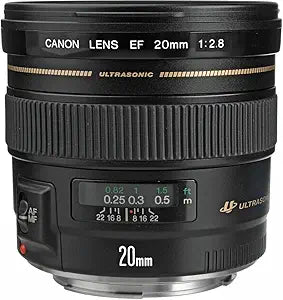
Canon 2509A003 EF 20mm f/2.8 USM Wide-Angle Lens
Capture Expansive Views with ClarityIntroducing the Canon EF 20mm f/2.8 USM Wide-Angle Lens. Designed for capturing a broader perspective with exceptional clarity, this lens is perfect for landscapes, interiors, and photojournalism. Focal Length: 20mm Maximum Aperture: f/2.8 Lens Construction: 1...
View price on Amazon
Affiliate Disclosure: As an Amazon Associate, Studio Supplies earns from qualifying purchases made through links on this page, at no additional cost to you. This helps support our editorial team.
Notice a mistake? Let Us Know
Overview
Capture Expansive Views with Clarity
Introducing the Canon EF 20mm f/2.8 USM Wide-Angle Lens. Designed for capturing a broader perspective with exceptional clarity, this lens is perfect for landscapes, interiors, and photojournalism.
- Focal Length: 20mm
- Maximum Aperture: f/2.8
- Lens Construction: 11 elements in 9 groups
- Angle of View: 94 degrees
- Focus Adjustment: Rear focusing system with USM
- Minimum Focus Distance: 0.8 feet
- Filter Size: 72mm
- Mount: Canon EF
- Dimensions: 3.1 inches diameter, 2.8 inches length
- Weight: 14.3 ounces (405g)
Key Features
Focal length and maximum aperture: 20mm 1:2.8
Lens construction: 11 elements in 9 groups
Diagonal angle of view: 94 Degree
Rear focusing system with USM focus adjustment
Closest focusing distance: 0.20m/0.66 ft.
EF mount; wide-angle lens
Floating system; inner focusing; full-time manual focus
20mm focal length
f/2.8 maximum aperture
Ring-type UltraSonic Motor (USM)
Lens not Zoomable
Specifications
Focal Length
20mm
Maximum Aperture
f/2.8
Lens Mount
Canon EF
Lens Construction
11 elements in 9 groups
Diagonal Angle of View
94 Degree
Focusing System
Rear focusing system with USM, Floating system, Inner focusing
Autofocus Motor
Ring-type UltraSonic Motor (USM)
Minimum Focusing Distance
0.20m / 0.66 ft.
Features
Full-time manual focus
Zoom Capability
Not Zoomable
Frequently Asked Questions
What is the maximum aperture of the Canon EF 20mm f/2.8 USM lens?
The Canon EF 20mm f/2.8 USM Wide-Angle Lens features a maximum aperture of f/2.8, which is beneficial for low-light photography and achieving a shallow depth of field.
Is this a zoom lens?
No, this is a fixed 20mm focal length lens and is not zoomable.
What kind of autofocus system does this lens use?
This lens is equipped with a Ring-type UltraSonic Motor (USM) for fast, quiet, and precise autofocus, and also allows for full-time manual focus override.
What is the closest distance this lens can focus?
The Canon EF 20mm f/2.8 USM lens has a closest focusing distance of 0.20 meters, or approximately 0.66 feet.
What is the diagonal angle of view provided by this lens?
This wide-angle lens offers a broad 94-degree diagonal angle of view, making it suitable for capturing expansive scenes.
How many elements and groups are in the lens construction?
The lens is constructed with 11 elements arranged in 9 groups to optimize optical performance.
Related Products


