Canon

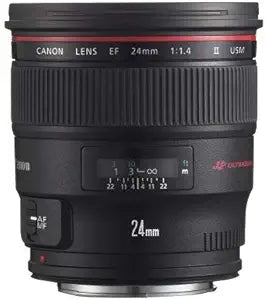
Canon 2750B002 EF 24mm f/1.4L II USM Wide Angle Lens, Renewed

5.0 (9 reviews)

Render architecture, interiors, and environmental portraits with edge-to-edge sharpness — the Canon 24mm f/1.4L II delivers an 84° field of view with L-series optical precision.

$799.99*$999.00Save 19%
In Stock on Amazon.com
View on Amazon

*Price sourced from Amazon.com. Last updated:Jul 14, 2026.Price and availability are subject to change.

Affiliate Disclosure: Studio Supplies may earn a commission from qualifying purchases made through links on this page, at no additional cost to you. This helps support our editorial team.

Notice a mistake? Let Us Know

Overview

The Canon EF 24mm f/1.4L II USM occupies a specific and irreplaceable creative position in the full-frame Canon system: it is the wide-angle prime that lets you shoot available-light interiors, dramatic dusk exteriors, and intimate environmental portraits without compromising on either field of view or maximum aperture. At 24mm and f/1.4, you can work in the dim ambient light of a reception hall or the last minutes of blue hour and still bring in enough light for a properly exposed, sharp image — the kind of shot that forces photographers shooting f/2.8 zooms to either raise ISO or accept motion blur. The 84° diagonal angle of view encompasses enough of a scene to tell the story of a location while the fast aperture lets you isolate a subject within that context.

Canon's second-generation L II optics represent a meaningful improvement over the original 24L, with aspherical elements controlling barrel distortion, UD glass suppressing lateral chromatic aberration, and the SWC coating addressing the ghosting that plagued the first version in high-contrast scenes. The ring-type USM delivers the instant, silent focus response that event, documentary, and wedding photographers depend on — there is no hunting, no lag, and full-time manual override without switching focus modes. The L-series construction means the barrel, mount, and control rings feel substantive and precise after years of regular use. For Canon DSLR shooters, this lens is a long-term investment that works across portraiture, architecture, travel, and photojournalism with equal authority.

Key Features

Lens not zoomable

Minimum focus Distance is 0.8ft

Focal Length -24 mm

Diagonal angle of view: 84

Specifications

Brand
Canon
Model
2750B002
Focal Length
24mm
Maximum Aperture
f/1.4
Lens Type
Fixed Wide Angle (Prime)
Minimum Focus Distance
0.8 ft (~24cm)
Angle of View
84° (diagonal)
Lens Mount
Canon EF
Condition
Renewed

Pros & Cons

👍 Pros

  • Shooting environmental portraits at f/1.4 on full-frame yields a distinctive separation between a sharp subject and a softly blurred 84° background — a creative look that no zoom can replicate at this focal length.
  • The aspherical and UD lens elements work together to suppress chromatic aberration and coma across the frame, producing clean, high-contrast files even in challenging backlit conditions.
  • The 0.8-foot minimum focus distance lets you build foreground-to-background compositions with strong perspective depth — a technique central to editorial, travel, and architectural photography.
  • Ring USM autofocus is fast, near-silent, and responsive enough to track subjects in documentary and event situations where you don't want the camera-to-subject relationship disrupted by audible focusing.
  • The L-series build quality — dust and moisture resistance, metal barrel construction — holds up across seasons of regular outdoor shooting in ways that consumer-grade glass does not.

👎 Cons

  • At f/1.4 corner sharpness falls short of center performance, which means architecture and landscape photographers who need edge-to-edge resolution will be stopping down to f/5.6 or narrower, underutilizing the fast aperture.
  • The 77mm front element and L-series barrel make this a physically substantial lens — after a full day of street or travel shooting the weight becomes more noticeable than with a compact prime.
  • Distortion at 24mm, while correctable in post, is visible in straight-line architectural subjects straight out of camera and requires lens correction profiles in Lightroom or Capture One to fully address.
  • As a renewed unit, the cosmetic condition and remaining service life are variables that don't exist with new glass — critical for photographers who need to resell gear with predictable residual value.
  • This is an EF-mount lens; Canon mirrorless R-series shooters will require an EF-EOS R adapter, adding cost, size, and one more connection point in the optical path.

Frequently Asked Questions

Wide open at f/1.4, the 24mm L II delivers impressive center sharpness that translates directly into usable files — environmental portraits at f/1.4 render subjects with a crisp plane of focus against beautifully separated backgrounds. Corner sharpness improves meaningfully by f/2.8, which is worth knowing for landscape or architecture work where edge detail matters.
This is a Canon EF-mount lens, compatible with all Canon EF-mount full-frame and APS-C DSLRs. On an APS-C crop body it delivers a 38mm equivalent field of view — a useful street and reportage focal length, though the wide-angle character is better realized on full-frame.
The minimum focus distance of 0.8 feet (approximately 24cm) gives you genuine close-focus capability for a rectilinear wide-angle lens. You can move in tight on foreground elements while retaining a wide environmental context behind — a technique that works well for editorial and documentary-style shooting.
The Sub-Wavelength Structure Coating is Canon's solution to ghosting and flaring caused by light hitting the rear elements at steep angles — a known challenge for fast wide-angle lenses when shooting toward strong light sources. In backlit scenes and night photography with city lights in frame, the SWC coating produces cleaner, more contrast-rich results than the previous 24mm f/1.4L version.
Yes, this listing is for a manufacturer-renewed lens. Renewed units have been inspected, tested, and certified to meet Canon's performance standards. Optical elements are examined for clarity and alignment. As with any renewed item, confirming the warranty terms at purchase is advisable before committing to professional use.