Canon

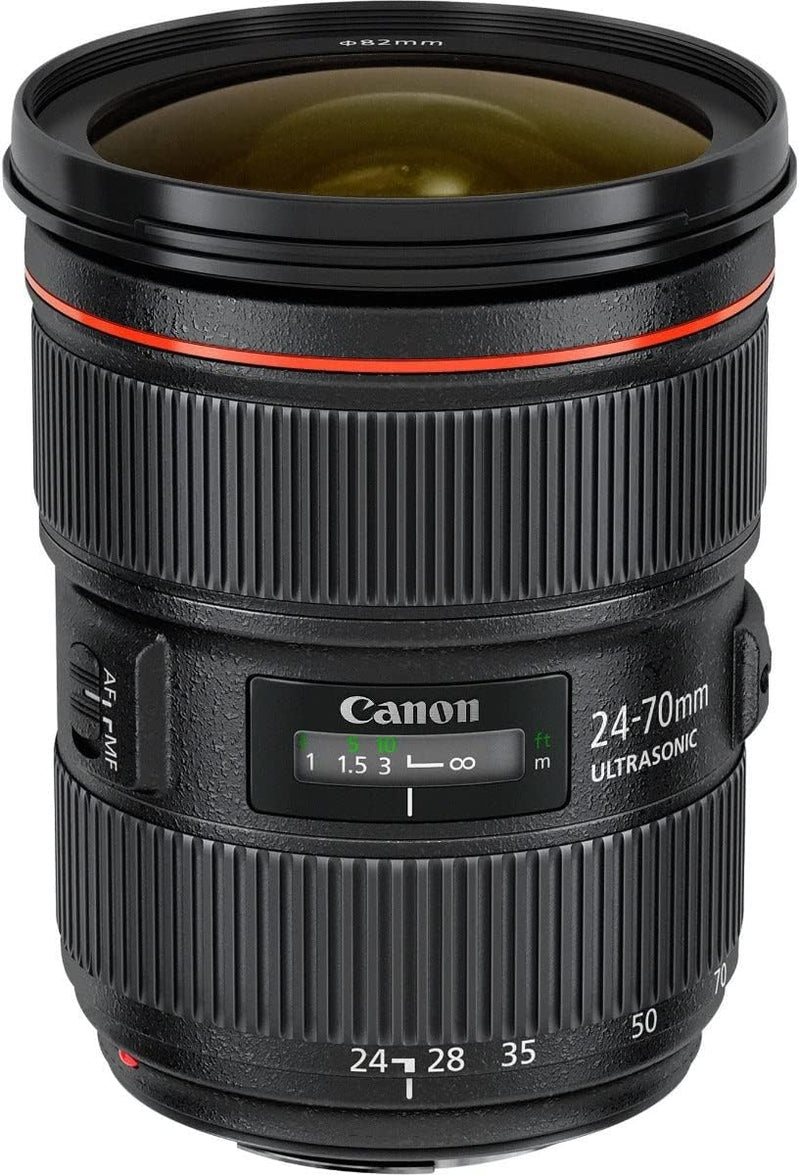
Canon 5175B002 EF 24-70mm f/2.8L II USM Zoom Lens

4.6 (982 reviews)
f/2.

The Canon EF 24-70mm f/2.8L II delivers tack-sharp results from environmental portraits to tight editorial frames, all with a constant f/2.8 through the full zoom range.

$2,199.00*
In Stock on Amazon.com
View on Amazon

*Price sourced from Amazon.com. Last updated:Jul 14, 2026.Price and availability are subject to change.

Affiliate Disclosure: Studio Supplies may earn a commission from qualifying purchases made through links on this page, at no additional cost to you. This helps support our editorial team.

Notice a mistake? Let Us Know

Overview

The Canon EF 24-70mm f/2.8L II USM is the standard zoom that professional Canon shooters reach for when a single lens needs to cover a full day of work — from environmental wide shots at 24mm to compressed portrait frames at 70mm, all without ever stopping down from f/2.8. That constant maximum aperture is the lens's defining performance characteristic: it allows you to shoot a wide establishing shot and immediately zoom to a tighter portrait without touching your exposure settings, which keeps pace with fast-moving events and candid documentary work. The ring-type USM motor delivers fast, near-silent autofocus with full-time manual override — a combination that suits photographers who refine focus manually after the AF locks, which is standard practice in portrait and editorial work. Sharpness across the frame at f/2.8 is a genuine strength of the II-generation design, outperforming its predecessor and competing favorably with prime lenses at equivalent focal lengths stopped down to f/4 and beyond.

The physical build reflects Canon's L-series standard — fluorine element coatings resist smearing and contamination in the field, and the dust and moisture resistance sealing makes this a credible outdoor option in light rain or dusty environments. The internal focusing and internal zoom design keep the lens at a consistent physical length regardless of where you are in the zoom range, which is important for filter use (82mm thread, non-rotating front element) and for tripod-mounted balance. At 1.7 pounds the lens earns its weight in optical performance, but it asks something of handheld photographers over extended sessions. The absence of image stabilization is the most practically significant gap in the specification sheet — photographers shooting on Canon bodies without IBIS will feel it at the long end in lower light, particularly as this lens sits in a competitive tier where IS has become increasingly standard from rival manufacturers.

Key Features

24-70mm focal length, 38.4-112mm equivalent focal length on Canon APS-C cameras

F2.8 constant maximum aperture; F22 minimum, Ring-type ultrasonic-type AF motor with full-time manual focusing

82mm filters, Closest Focusing Distance: 0.38m/1.25 ft.

Image Stabilization : No

Purchase this product between May 1, 2016 and July 30, 2016 and get 13 months of free damage protection from Canon. The product must be registered within 30 days of the purchase date to be eligible.

Specifications

Focal Length
24–70mm
Maximum Aperture
f/2.8 (constant)
Minimum Aperture
f/22
Lens Mount
Canon EF
Filter Thread
82mm
Minimum Focusing Distance
0.38m / 1.25 ft.
Autofocus Type
Ring-Type USM
Image Stabilization
No
Weight
1.7 lbs
APS-C Equivalent Focal Length
38.4–112mm

Pros & Cons

👍 Pros

  • The constant f/2.8 aperture across the full 24–70mm zoom range holds exposure settings stable through focal length changes, which is essential for consistent results across an event or portrait session without continuous exposure compensation.
  • Ring-type USM autofocus is fast, quiet, and precise — it tracks moving subjects reliably across the zoom range and allows full-time manual focus override without switching AF off, which experienced shooters use constantly for final focus refinement.
  • The internal focusing design keeps the physical lens length constant during focus and zoom, meaning 82mm polarizers stay aligned and the lens handles balance consistently on the camera body throughout a shoot.
  • At 0.38m minimum focusing distance, this lens can be pressed into close-range product and detail work that a standard zoom would struggle with — useful when a macro lens isn't part of the kit.
  • Canon's L-series build quality — fluorine coating on the front and rear elements, dust and moisture resistance sealing — holds up through repeated professional use and harsh outdoor conditions without degrading optical performance.

👎 Cons

  • At approximately 1.7 pounds, the 24-70mm f/2.8L II is a heavy lens for a standard zoom — fatigue becomes noticeable during long handheld sessions like all-day weddings or extended documentary shoots where the camera rarely comes down.
  • There is no optical image stabilization, which is an increasing competitive disadvantage as rival 24-70mm f/2.8 options from Sony, Nikon, and Tamron have incorporated IS/VR/VC without sacrificing optical quality.
  • The 82mm filter thread adds cost to filter purchases — 82mm polarizers, ND filters, and protection filters carry a measurable price premium over the more common 77mm size, and existing 77mm filter collections become incompatible.
  • Maximum aperture of f/2.8 is wide but not as shallow-depth-of-field as prime alternatives at equivalent focal lengths — photographers who shoot f/1.4 or f/1.8 primes for subject separation will find the standard zoom's background blur less pronounced.

Frequently Asked Questions

The aperture stays at f/2.8 across the entire 24–70mm range without any reduction. This is critical for event and studio work — you set your exposure once and it doesn't shift as you reframe from a wide environmental shot to a tighter portrait, keeping your shutter speed and ISO consistent throughout a sequence.
The f/2.8 maximum aperture is wide enough to shoot in low ambient light — reception halls, gallery openings, conference rooms — without forcing you to unacceptable ISO levels on modern full-frame bodies. The ring-type USM autofocus motor is fast and nearly silent, which is an asset when working candidly in quiet venues.
For the focal lengths covered (24–70mm), modern bodies with IBIS can compensate, and at f/2.8 the shutter speeds needed to freeze motion are achievable in most well-lit environments. However, photographers shooting handheld in very low light at 70mm on bodies without sensor stabilization will notice the absence of IS compared to competing lenses that include optical stabilization at this focal length.
The filter thread is 82mm — notably larger than the 77mm common to older L-series glass. The 24-70mm f/2.8L II uses an internal focusing design, so the front element does not rotate during focus. This makes it fully compatible with polarizing filters and graduated NDs without requiring rotation adjustment after focusing.
The EF mount is compatible with all Canon EOS DSLRs including APS-C bodies. On an APS-C sensor, the 1.6x crop factor gives an effective range of approximately 38.4–112mm, which behaves more like a portrait-to-telephoto zoom than a standard wide-to-short-tele — useful for tighter compositions but less useful for environmental wide shots on crop-sensor bodies.