



Canon
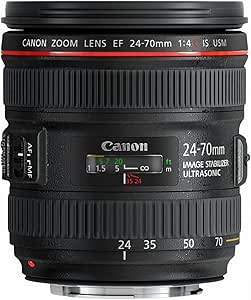
Canon 6313B002 EF 24-70mm f/4L IS USM Zoom Lens
Pack light, shoot sharp — Canon's L-series 24-70mm f/4 IS delivers tack-sharp images from sweeping landscapes to close-up macro detail without the bulk of f/2.8.
View price on Amazon
Affiliate Disclosure: As an Amazon Associate, Studio Supplies earns from qualifying purchases made through links on this page, at no additional cost to you. This helps support our editorial team.
Notice a mistake? Let Us Know
Overview
Key Features
L‐Seriesstandardzoomlensdeliverssuperbimagequalityinacompact,lightweightdesign
2 aspheric and 2 UD lens elements for high image quality throughout the entire zoom range
Fullmacroshootingmodewithupto0.7xmagnification,easilyaccessiblewithaone‐touch switch at the extreme telephoto end
Image stabilization effective up to 4 shutters peed stops and Hybrid IS compensates for both angular and shift types of camera shake for macro shooting
Resistanttodustandwater,enablingshootingeveninharshandrigorousconditions
Specifications
Focal Length
24–70mm
Maximum Aperture
f/4
Lens Construction
15 elements in 12 groups
Angle of View
84°–34°
Focus System
Inner focusing, Ring-type USM
Closest Focusing Distance
0.38m (1.25 ft)
Maximum Magnification
0.7x (macro mode)
Filter Diameter
77mm
Image Stabilization
Hybrid IS, up to 4 stops
Weight
600g (approx. 21 oz)
Mount
Canon EF
Frequently Asked Questions
Is this lens fully compatible with Canon APS-C crop-sensor bodies?
Yes, it mounts on any EF-mount Canon body, but it's engineered for full-frame. On APS-C you'll get an effective 38-112mm equivalent — useful range, but the compact wide end disappears. For full creative leverage, pair it with a 5D or 6D series body.
How useful is the 4-stop Hybrid IS in handheld available-light shooting?
In practical terms, at 70mm you can confidently shoot at 1/15s — speeds that would produce blur with a non-IS lens. The Hybrid IS compensates for both angular shake and the shift-type movement that plagues handheld macro work, so you'll see a noticeable hit rate improvement in dim event venues or indoor natural light.
What does the macro mode actually enable, and how do you engage it?
At the 70mm end, a one-touch switch unlocks a 0.7x magnification mode, bringing minimum focus down to 0.38m. That's genuine close-up capability — more than enough for product detail, flower petals, or small objects. You won't replace a dedicated macro lens, but for travel photographers it eliminates carrying one.
How does the f/4 aperture affect bokeh compared to the 24-70mm f/2.8 II?
At equivalent distances, the f/2.8 produces meaningfully shallower depth of field and more aggressive background separation. At f/4 you'll still isolate a portrait subject cleanly at 70mm with a close focus distance, but full-length or environmental portraits will render more background detail. It's a deliberate trade-off: sharpness, IS, and macro capability for one stop of light.
Does the 77mm filter thread accept circular polarizers without vignetting?
Yes — the 77mm front element accepts standard CPL and ND filters without vignetting at any focal length. The inner focusing system means the front element doesn't rotate during AF, so your CPL orientation stays exactly where you set it.
Related Products


