



Canon
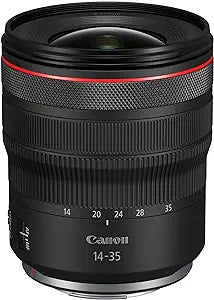
Canon CRTCNRF1435F4L RF 14-35mm f/4 L USM Lens (Renewed)
f/4
Canon's RF 14-35mm f/4 L covers an entire ultra-wide zoom range at constant f/4 with 5.5 stops of IS — tack-sharp architecture, landscape, and handheld video from 14mm on full-frame.
View price on Amazon
Affiliate Disclosure: As an Amazon Associate, Studio Supplies earns from qualifying purchases made through links on this page, at no additional cost to you. This helps support our editorial team.
Notice a mistake? Let Us Know
Overview
Key Features
This Certified Refurbished product is manufacturer refurbished it shows limited or no wear
Includes all original accessories plus a 90 day warranty
Canon RF 14-35mm f/4 L IS USM Ultra Wide Zoom Full Frame Lens for RF Mount
Create dramatic, high quality photos and videos covering an entire wide-angle zoom range | Bright, constant f/4 with L-series construction | Optical Image Stabilizer up to 5.5 stops | Fast, smooth, quiet Nano USM AF | Weather & Dust Resistant
INCLUDED IN THE BOX: Canon RF 14-35mm F4 L IS USM Full Frame Ultra Wide Angle Zoom Lens for RF Mount Mirrorless Cameras | Lens Cap E-77II | Lens Hood EW-83P | Lens Pouch LP1219
Specifications
Model
RF 14-35mm f/4 L IS USM (CRTCNRF1435F4L)
Focal Length
14–35mm
Maximum Aperture
f/4 (Constant)
Lens Mount
Canon RF
Image Stabilization
Optical IS, up to 5.5 stops (7.5 stops combined with IBIS)
Autofocus
Nano USM
UD Elements
4x Ultra-Low Dispersion
Filter Thread
77mm
Weather Resistance
Yes (Dust and Weather Resistant)
Coatings
Air Sphere + Fluorine
Condition
Manufacturer Certified Renewed (90-day warranty)
Frequently Asked Questions
Does "certified refurbished" affect image quality or long-term reliability for this lens?
No — Canon's certified refurbished process returns lenses to manufacturer specifications, and the unit ships with original accessories plus a 90-day warranty. Optically, a refurbished Canon RF 14-35mm f/4 L performs identically to new; the designation affects cost and packaging, not the lens elements, coatings, or IS unit. For a photographer on a budget, it's one of the most rational ways to access L-series quality.
Is this lens compatible with Canon EF-mount DSLRs?
No — the RF 14-35mm f/4 L IS USM is exclusively for Canon RF-mount mirrorless cameras. There is no adapter that allows RF-mount lenses to work on EF-mount DSLR bodies. Compatible bodies include EOS R, R3, R5, R6, RP, Ra, and compatible RED cinema bodies with RF mounts.
What is the practical advantage of 5.5 stops of optical IS at ultra-wide focal lengths?
At 14mm, camera shake is rarely the limiting factor — but at 35mm handheld in dim interiors, 5.5 stops allows usable exposures at shutter speeds that would otherwise require a tripod. Combined with in-body IS on the R5, R6, or R3, the system reaches 7.5 stops of combined stabilization — enabling near-dark handheld shooting that changes your tripod dependency entirely.
How does the 5.5 stops of optical image stabilization affect handheld shooting in low light at 14mm?
At 14mm, the reciprocal rule suggests 1/15s as the minimum safe handheld shutter speed without IS. With 5.5 stops of IS correction, you can theoretically shoot down to approximately 1/0.5s — around half a second — with a reasonable keeper rate. In practice, subject motion still blurs at long exposures, but architectural interiors and landscape scenes at dusk become genuinely hand-holdable that would otherwise require a tripod.
How does the constant f/4 aperture behave across the 14-35mm zoom range on a full-frame RF body?
The constant f/4 maintains identical exposure settings and depth of field characteristics across the entire zoom range — no need to compensate exposure as you zoom from 14mm to 35mm. This is particularly useful for video work where a zoom during a shot would otherwise cause exposure fluctuation with a variable-aperture lens.
How does the constant f/4 aperture affect shooting across the zoom range?
Constant f/4 means exposure, depth of field, and autofocus behavior remain identical whether you're at 14mm or 35mm — unlike variable aperture lenses that stop down to f/5.6 or f/6.3 at the long end. In dim interiors, knowing your aperture won't shift mid-composition prevents surprise underexposures during handheld shooting.
What does Nano USM autofocus offer specifically for video work?
Nano USM delivers fast, smooth, and nearly silent autofocus — critical for video where AF motor noise is picked up by on-camera microphones. Its smooth ramping behavior avoids the "lurch" of conventional USM during focus pulls, making this lens genuinely usable for run-and-gun video without a separate follow focus system.
Is the Nano USM autofocus quiet enough for video use on mirrorless RF bodies?
Yes — Nano USM is Canon's quietest AF motor type, specifically designed to minimize lens motor noise during video recording. On RF mirrorless bodies with continuous AF in video mode, the Nano USM drive is essentially inaudible in the recorded audio, even with an on-camera microphone at moderate gain levels.
Does this lens cover full-frame sensors, and does it produce vignetting at 14mm wide open?
Yes — this is a full-frame RF mount lens designed for Canon EOS R full-frame bodies. Some vignetting at 14mm f/4 is expected in the corners as with all ultra-wide lenses, though Canon's L-series optical design minimizes it compared to third-party ultra-wides at this focal length. In-camera and Lightroom lens correction profiles eliminate residual vignetting in post with no meaningful image quality penalty.
What is the filter thread size, and is this lens weather sealed?
The RF 14-35mm uses a 77mm filter thread — a common professional standard shared with many 70-200mm and 24-70mm L lenses. The lens is dust- and weather-resistant at L-series standard, sealed at the mount and key joints, appropriate for field work in light rain and dusty environments.
Related Products


