Cokin

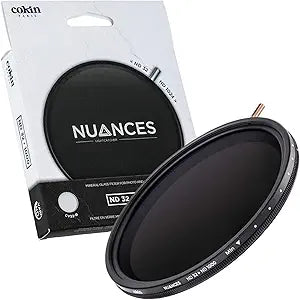
Cokin CNV32-62 Nuances Variable ND Filter 62mm

4.1 (2 reviews)

Drag shutter speeds from 1/1000 to 1 second in one twist — the Cokin Nuances ND32-1000 variable filter opens five to ten stops of creative exposure control.

$65.02*
Check availability

*Price sourced from Amazon.com. Last updated:Jul 14, 2026.Price and availability are subject to change.

Affiliate Disclosure: Studio Supplies may earn a commission from qualifying purchases made through links on this page, at no additional cost to you. This helps support our editorial team.

Notice a mistake? Let Us Know

Overview

The Cokin Nuances CNV32-62 is a variable neutral density filter — a single circular filter that replaces a set of fixed ND filters by allowing continuous density adjustment from ND32 (5 stops) to ND1000 (10 stops) with a rotation of the front ring. In practical terms, this translates directly to creative aperture and shutter speed freedom: five stops of reduction lets you shoot a portrait at f/1.8 in bright outdoor light without blowing the exposure; ten stops lets you drag a waterfall to a 30-second silky exposure in full daylight. The key optical choice that elevates this filter above entry-level variable NDs is Schott B270 glass — a precision optical glass with tightly controlled refractive index and high transmission, chosen for its color neutrality. Paired with Cokin's 16-layer EVERCLEAR 5 anti-reflection coating, the filter minimizes flare, ghosting, and the color cast that cheaper variable ND constructions introduce.

The filter's front ring is demarcated with stop markers and includes a dedicated rotation lever — a small but genuinely useful field ergonomic that lets photographers make density adjustments with precision using a single finger rather than gripping and turning the entire filter housing. The 62mm thread fits the front element of lenses in the standard mid-telephoto and zoom range that commonly use this filter diameter. The CNV32-62 is built for photographers and filmmakers who want to simplify their filter kit without compromising optical quality — it's not a substitute for a high-end matte box and fixed ND system in a professional cinema workflow, but for stills photographers and hybrid shooters, it provides the density control needed for creative long-exposure and wide-aperture work in a compact, single-filter solution.

Key Features

Variable Neutral Density Filter

Reduces Exposure by 5 to 10 Stops

Darkens Entire Image

Greater Control over Exposure Settings

Constructed from Schott B270 glass for increased optical clarity and color fidelity.

Specifications

Filter Type
Variable Neutral Density (ND)
Filter Size
62mm
Exposure Reduction
5 to 10 Stops
Effect
Darkens Entire Image
Glass Material
Schott B270
Optical Clarity
Increased
Color Fidelity
Increased
Brand
Cokin

Pros & Cons

👍 Pros

  • The 5-to-10 stop density range is broad enough to handle both bright overcast outdoor conditions and direct midday sunlight from a single filter, reducing how many fixed ND filters you need to carry.
  • Schott B270 glass is optical quality glass selected for color neutrality — significantly better light transmission characteristics and less color shift than cheap polycarbonate variable NDs that corrupt white balance.
  • The 16-layer EVERCLEAR 5 anti-reflection coating reduces flare and ghosting from bright light sources entering the filter — a real-world optical advantage when shooting toward the sun or strong artificial lights.
  • The demarcated density scale and rotation lever enable repeatable, precise exposure adjustments in the field — you can return to a specific stop value reliably rather than guessing by ring position.
  • At 62mm, this filter keeps flare-resistant optical quality within the reach of a mid-telephoto and standard zoom portfolio — a better choice than using a step-up ring and a larger filter that may introduce vignetting.

👎 Cons

  • At maximum density (ND1000, 10 stops), all variable ND filters using crossed polarizers risk a visible dark cross or uneven density pattern across the frame — this is an inherent physics limitation of the technology, not specific to Cokin, but it is noticeable at the high end of the range.
  • Variable ND filters add two polarizing optical elements to the light path, which can introduce very subtle softness compared to shooting without a filter — noticeable primarily in extreme sharpness comparisons but a consideration for critical optical testing.
  • The 62mm thread size is specific — photographers shooting with 77mm or 82mm lens fleets will need a step-up ring, which adds a potential vignetting risk on wide-angle lenses at the 5-stop end of the density range.
  • At high ND densities (ND1000), autofocus systems on many cameras struggle due to the extremely reduced light reaching the sensor — you may need to manually compose and focus before rotating to maximum density.
  • No hard stop at the minimum density setting means there's a risk of accidentally rotating the filter below its marked ND32 minimum, entering an undefined density zone that can cause uneven exposure.

Frequently Asked Questions

Dialing in more density — up to 10 stops — lets you shoot at wide apertures like f/1.8 or f/2.8 in broad daylight without overexposing. This means you can maintain shallow depth of field for portraiture or achieve silky motion blur in waterfalls and traffic even under bright midday light, creative outcomes that a fixed aperture alone can't deliver outdoors.
The Cokin Nuances uses Schott B270 glass with 16-layer EVERCLEAR 5 anti-reflection coating to minimize color cast and flare. Higher-quality glass like B270 is selected specifically for color neutrality — shift is reduced compared to cheaper variable ND constructions, though some subtle color change at the extremes of the range (near ND1000) is a characteristic of variable ND design physics rather than a manufacturing defect.
Variable ND filters that use crossed polarizing elements can exhibit a dark "X" pattern at their maximum density settings — this is a known limitation of polarizer-based variable NDs including this design. The CNV32-62's range stops at ND1000 (10 stops) rather than pushing further, which is calibrated to keep this artifact controlled, but rotating beyond the marked maximum range should be avoided.
The front ring is demarcated with density markings and includes a small rotation lever for precise, one-handed density adjustment — a useful ergonomic detail when your other hand is on the zoom ring or a tripod control. It allows fine adjustments without gripping the filter housing directly.
The CNV32-62 is threaded specifically for 62mm lens filter threads. Check your lens's front element thread diameter — typically marked on the lens barrel with a Ø symbol — to confirm 62mm fitment before purchasing.