



Cokin
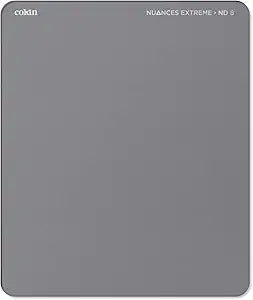
Cokin NXP8 NUANCES Extreme ND8 3-Stop Filter: P-Series
Reclaim the sky without blowing your exposure — the Cokin NUANCES Extreme ND8 drops three stops of light into your landscape frame with glass-sharp precision.
$82.88*
View on Amazon
✓ In Stock on Amazon.com
*Price sourced from Amazon.com. Last updated:Aug 28, 2026.Price and availability are subject to change — details.
Affiliate Disclosure: As an Amazon Associate, Studio Supplies earns from qualifying purchases made through links on this page, at no additional cost to you. This helps support our editorial team.
Notice a mistake? Let Us Know
Overview
Key Features
For Cokin P Series Holders
Up to 8x Filter Factor, 3-Stop
Reduce Exposure in Selective Areas
Soft-Edged Line of Transition
Hydrophobic coatings result in an improved beading effect when in contact with water for greater cleaning efficiency
Specifications
Filter Type
Graduated Neutral Density
Density
ND8 (3-Stop)
Filter Factor
Up to 8x
Compatibility
Cokin P-Series filter holders
Transition Style
Soft-Edge
Material
Tempered, shock-resistant glass
Coating
Nano-metallic alloy film; anti-glare and hydrophobic coatings
Edge Shape
C-Shaped
Brand
Cokin
Model
NXP8
Frequently Asked Questions
Which Cokin holder system does this filter fit?
This filter is sized and shaped specifically for the Cokin P-Series holder system. It will not fit Cokin Z-Pro (larger) or A-Series (smaller) holders — verify your holder before ordering.
What does a 3-stop / ND8 reduction mean for my shooting?
Three stops of light reduction means you can open your aperture three stops wider, extend your shutter speed by 8x, or some combination of both compared to shooting without the filter. In practice, this opens up creative options like achieving a shallower depth of field in bright conditions or blurring water movement in a daylight scene.
What is the soft-edge transition, and when should I use it instead of a hard-edge graduated filter?
The soft-edge transition creates a gradual fade from the darkened zone to the clear zone rather than a sharp line. Use it when your horizon is irregular — treelines, mountains, buildings — where a hard line would create a visible density edge cutting through non-sky elements. Flat oceanic or desert horizons can use either, but soft-edge is the safer general choice.
Does the nano-metallic alloy film coating affect color neutrality?
The NUANCES Extreme line is engineered for color neutrality — the nano-metallic alloy coating is designed to reduce the color cast that afflicts cheaper resin GND filters. As with all GND filters, slight color shifts at the transition zone are possible under extreme lighting conditions, but the glass construction and coating quality keep this minimal compared to entry-level alternatives.
How does the hydrophobic coating help in the field?
The hydrophobic coating causes water droplets to bead and roll off the filter surface rather than sheeting across it. In rainy coastal or waterfall shooting conditions, this means fewer shooting interruptions to wipe the filter and faster drying when spray hits the glass.
Related Products


