

Elite Screens
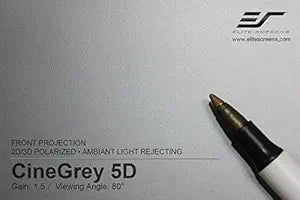
Elite Screens CineGrey5D Ambient Light Rejecting Screen Sample
Experience the CineGrey 5D's ambient-light-rejecting performance firsthand — this material sample lets you evaluate contrast and color accuracy before committing to a full screen purchase.
$9.99*
View on Amazon
✓ In Stock on Amazon.com
*Price sourced from Amazon.com. Last updated:Sep 04, 2026.Price and availability are subject to change — details.
Affiliate Disclosure: As an Amazon Associate, Studio Supplies earns from qualifying purchases made through links on this page, at no additional cost to you. This helps support our editorial team.
Notice a mistake? Let Us Know
Overview
Specifications
Brand
Elite Screens
Model
CineGrey5D-SM
Material Type
CineGrey 5D Angular Reflective
Screen Type
Front Projection
Key Technology
Ambient Light Rejection (ALR)
SKU Type
Material Sample
Frequently Asked Questions
What does "angular reflective" mean for a projection screen material, and why does it matter for room placement?
Angular reflective means the material is engineered to reflect light back toward viewers seated directly in front of the screen rather than diffusing it uniformly. This geometry is the mechanism behind ambient light rejection — ceiling-mounted projector light hits the screen at a controlled angle and reflects toward the audience, while ambient light from windows or overhead fixtures strikes at a different angle and is rejected. Projector placement relative to viewing position is therefore critical for this material to perform as intended.
Can this sample be used to test the CineGrey 5D's performance with my specific projector and room lighting conditions?
Yes — that is the explicit purpose of this sample listing. Testing the material with your actual projector, at your throw distance, under your room's ambient light conditions is the most reliable way to evaluate whether the CineGrey 5D delivers the contrast improvement your room requires before purchasing a full-size screen.
Does the CineGrey 5D require a specific projector type — DLP, LCD, or laser — to perform correctly?
The screen material is projector-technology agnostic. However, the angular reflective design is optimized for projectors mounted at or near the ceiling in a standard throw position. Short-throw and ultra-short-throw projectors project from angles that fall outside the material's designed rejection geometry, and performance with those units should be specifically evaluated using this sample before purchase.
What gain level does the CineGrey 5D material produce, and what does that mean for black levels?
Elite Screens specifies the CineGrey 5D as a high-gain material. Higher gain concentrates reflected light toward the viewing axis, improving perceived brightness in ambient light — but this also narrows the optimal viewing cone and can affect off-axis color uniformity. The sample allows evaluation of this trade-off in your specific seating layout.
Is this sample representative of the full-screen material, or is it a simplified version for evaluation only?
This is the actual CineGrey 5D projection material — the same angular reflective coating used in the full production screens. What it does not replicate is the tensioning system, border finish, or mounting of an installed screen, but the optical performance of the material itself is directly transferable to your evaluation.
Related Products


