


Focusrite Scarlett 2i2 Studio (3rd Gen) Bundle — Editorial Review & Independent Findings
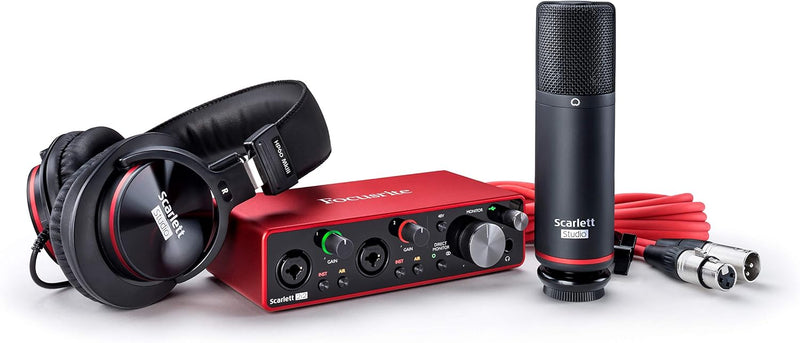
The Focusrite Scarlett 2i2 Studio 3rd Gen (AMS-SCARLETT-2I2-STU-3G) is Focusrite's all-in-one entry-tier home-recording kit, built around the 3rd-generation Scarlett 2i2 USB-C audio interface with a CM25 MkIII condenser microphone, HP60 MkIII closed-back headphones, an XLR cable, and a USB-C cable in the box. Per Focusrite's official Scarlett 2i2 Studio 3rd Gen product page, the bundle is positioned as the lowest-friction path from zero recording gear to a complete tracking setup capable of recording a vocalist + guitarist simultaneously. The findings below aggregate independent coverage from authoritative pro-audio and music-instrument publications.
Sound on Sound — The Pro-Audio Authority's Take
Sound on Sound's review of the 3rd-generation USB-C Scarlett range documents the measurable improvements over the previous generation. The publication's tested findings: the 3rd-gen Scarlett preamps deliver 56 dB of gain (a 6 dB increase over the 2nd gen's 50 dB) and 111 dB analog-input dynamic range (up from the 2nd gen's 109 dB), with reduced total harmonic distortion across all analog I/O. Sound on Sound also documents the new Air mode: a switchable high-frequency boost that emulates the classic transformer-based ISA mic preamps Focusrite is best known for in pro studios. Sound on Sound's framing is direct — the Scarlett range offers excellent value for money with improved audio specifications and the Air option on all mic preamps.
What the Air Mode Actually Does
Per Focusrite's official Air mode explainer, Air mode is a switchable preamp coloration designed to emulate the high-frequency response of Focusrite's ISA range (a transformer-based mic preamp design used in many commercial recording studios). Practical effect: on sources with a softer top end (warm dynamic mics, ribbon mics, some acoustic guitars), Air mode adds presence and air without needing a separate EQ. On sources that are already bright (most condenser mics on bright vocalists, electric guitar DI tones), Air mode may push too much — leaving it off is the right choice. The flexibility of having both options available per channel is a meaningful step up from older entry-tier interfaces that don't offer ISA-style coloration at all.
The Bundle Components in Context
- Scarlett 2i2 (3rd Gen) Interface. Two combo XLR/TRS inputs, two TRS line outputs, USB-C bus power, 24-bit/192 kHz converters per Focusrite's official specifications page. Stand-alone, this interface remains the most-shipped USB-C audio interface in its class
- CM25 MkIII Condenser Microphone. Large-diaphragm cardioid condenser, included as the kit's vocal/instrument capture microphone. Powered via the 2i2's 48 V phantom. Per the Focusrite Studio bundle product page, the CM25 MkIII is voiced for clarity in vocals and acoustic guitar capture — typical of entry-tier large-diaphragm condensers
- HP60 MkIII Closed-Back Headphones. Closed-back design for tracking (avoids bleed from headphone signal into the recording microphone). Guitar World's review characterizes the HP60 as "decent reference cans" — appropriate for tracking and headphone-mix duties but not the publication's first choice for critical mixing. For mixing work, most users step up to a dedicated mixing headphone (Sony MDR-7506, Beyerdynamic DT 770) or studio monitors
- Cables included. One XLR cable for the microphone and one USB-C-to-USB-A cable for the interface. The XLR cable is consumer-tier (functional, not pro-grade) and is the most likely item users upgrade first
Workflow Strengths
- Single-purchase complete tracking setup. Per the Studio bundle product page, everything needed to record a vocalist + guitarist (instrument input on channel 2) ships in one box. This eliminates the analysis-paralysis problem of selecting compatible interface/mic/headphone components individually
- Class-compliant USB-C — no driver install on macOS, single Focusrite Control driver on Windows. Plug-and-play setup on a Mac; minimal-friction setup on Windows. The interface is widely compatible with Logic Pro, Pro Tools, Ableton Live, FL Studio, GarageBand, Reaper, and every other major DAW
- Bundled software. Focusrite typically includes Pro Tools | First (or Pro Tools Artist trial), Ableton Live Lite, and various plugins as included downloads. Newcomers to recording can start tracking immediately without a separate software purchase
- USB bus power — no separate wall-wart. The 2i2 draws all its power from the USB-C connection, which simplifies portable / laptop-based recording workflows
Honest Cons from Independent Coverage
- The HP60 MkIII headphones are tracking-grade, not mixing-grade. Per Guitar World's review, the HP60 cans deliver a fairly balanced but somewhat closed-back soundscape — fine for tracking and headphone-mix monitoring, less suitable for critical mixing decisions. Users planning to mix on headphones should step up to a dedicated mixing pair
- CM25 MkIII is voiced for clarity, not character. The included condenser is a competent neutral-bright capture mic but doesn't have the character of pricier condensers (AKG C214, Audio-Technica AT4040, Rode NT1) or large-diaphragm broadcast dynamics (Shure SM7B). For vocal performances where mic character matters, the included CM25 is a starting point, not the destination
- Two inputs cap simultaneous recording at 2 tracks. For solo recording (vocal + acoustic, vocal + DI bass, two-mic acoustic guitar) the 2-input limit is fine. For drum kits, band tracking, or podcast setups with 3+ hosts, the Scarlett 4i4 or 8i6 in the same family is the correct step-up
- Air mode can be too much on bright sources. Per Sound on Sound's coverage, Air mode's high-frequency boost "simply anticipates what you'd have done at the mix anyway, but you do need to be careful with sources or mics that already have a lot of top end." Operator judgement required on a per-source basis
- USB-C cable supplied is C-to-A. Modern laptops with USB-C only (recent MacBook Air / Pro, ThinkPad X1 Carbon) need a USB-C-to-USB-C cable or adapter, not supplied in the box
Where the Scarlett 2i2 Studio Bundle Specifically Fits
- Singer-songwriters tracking vocals + acoustic guitar from a home setup — exactly the workflow the kit is designed for
- Podcasters and YouTube creators moving from a USB microphone to a proper XLR + interface workflow — the bundle covers the upgrade path completely in one purchase
- First-time home-recording producers who don't yet know which microphone / headphones they prefer and want a complete starter kit at a fixed price
- Students at music schools and colleges who need a portable tracking setup for assignment recording — bus-powered USB-C is laptop-friendly
- Streamers and Twitch creators wanting broadcast-quality voice via XLR condenser instead of a USB headset; the 2i2's two channels handle mic + guitar DI for music streamers
Where Buyers Should Look Elsewhere
- Band tracking / drum kits / 3+ simultaneous microphone inputs — step up to Scarlett 4i4 (Studio bundle version available) or 8i6 in the same 3rd Gen family
- Critical mix-on-headphones workflows — pair the 2i2 with dedicated mixing headphones (Sony MDR-7506, Beyerdynamic DT 770 Pro 80 ohm) rather than the bundled HP60
- Vocalists wanting a character-driven condenser — substitute or supplement the CM25 with a Rode NT1, AKG C214, or Audio-Technica AT4040 for more pronounced vocal character
- Broadcast podcasters wanting the iconic Shure SM7B — the SM7B's low output level pairs better with interfaces offering Cloudlifter-style additional gain (or with the Scarlett 2i2's Air mode + max gain, though the 2i2 is on the lower-output edge of SM7B compatibility)
Sources & Citations
- Focusrite, "Scarlett 2i2 Studio (3rd Gen) Recording Bundle product page," us.focusrite.com (accessed 2026-05-17)
- Focusrite, "Scarlett 2i2 (3rd Gen) product page," us.focusrite.com (accessed 2026-05-17)
- Focusrite, "Scarlett 2i2 3rd Gen — Official Specifications," userguides.focusrite.com (accessed 2026-05-17)
- Focusrite Support, "What is ‘Air’ on my interface?," support.focusrite.com (accessed 2026-05-17)
- Sound on Sound, "Focusrite Scarlett USB-C (3rd Generation) review," soundonsound.com (accessed 2026-05-17)
- Guitar World, "Focusrite Scarlett 2i2 3rd Gen review," guitarworld.com (accessed 2026-05-17)
Last verified: 2026-05-17


