


Fujifilm
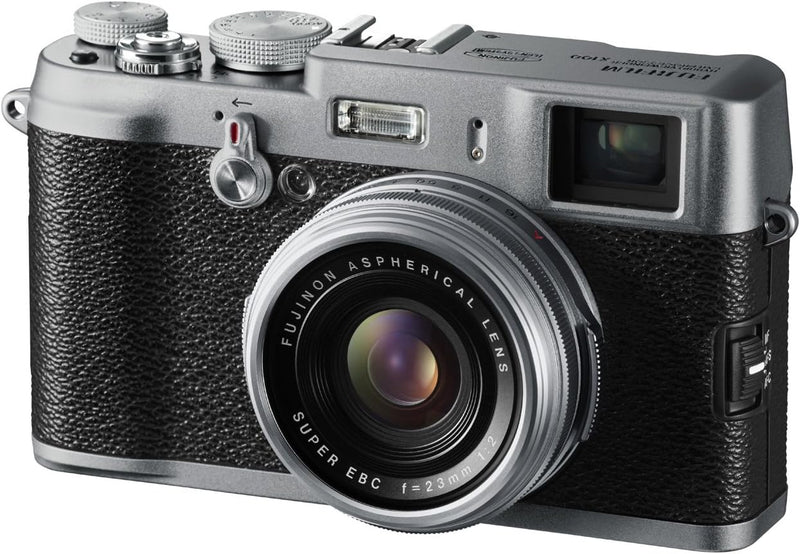
Fujifilm X100 12.3MP Digital Camera 23mm Lens Hybrid Viewfinder
3MP
Fixed 23mm f/2 on APS-C with a legendary hybrid viewfinder — the X100 is the camera that changed how photographers think about deliberate compact shooting.
$1,299.99*
View on Amazon
✓ In Stock on Amazon.com
*Price sourced from Amazon.com. Last updated:Aug 30, 2026.Price and availability are subject to change — details.
Affiliate Disclosure: As an Amazon Associate, Studio Supplies earns from qualifying purchases made through links on this page, at no additional cost to you. This helps support our editorial team.
Notice a mistake? Let Us Know
Overview
Key Features
12.3-megapixel APS-C CMOS sensor
Newly-developed lens offers a focal length of 23mm (135 equivalent: 35mm) and a widest aperture of F2. Made from molded glass, the lens contains 8 elements in 6 groups
Hybrid Viewfinder combines the window-type "bright frame" optical viewfinder, and the electronic viewfinder system
HD Movie Mode; capture 720p video
Specifications
Megapixels
12.3MP
Sensor Type
APS-C CMOS sensor
Lens Focal Length
23mm (135 equivalent: 35mm)
Lens Aperture
F2
Lens Construction
8 elements in 6 groups, molded glass
Viewfinder Type
Hybrid Viewfinder (optical and electronic)
Video Recording
HD Movie Mode (720p)
Frequently Asked Questions
Is the original Fujifilm X100 still capable for street and documentary work today?
Absolutely. The 12.3MP APS-C CMOS sensor produces detailed, film-like files with excellent tonal gradation, particularly in RAW processed through Lightroom or Capture One. The 23mm f/2 Fujinon renders beautifully at f/2-f/4. The honest limitation is the contrast-detect autofocus, which requires more patience in low light than current cameras demand — but for deliberate, zone-focus street shooting, it is entirely capable.
Can I change lenses on the X100?
No — the 23mm f/2 Fujinon is permanently integrated into the body. Fujifilm offers the WCL-X100 wide conversion lens and TCL-X100 tele conversion lens as front-element accessories that attach to the filter thread, approximating 28mm and 50mm equivalents respectively, though with some image quality trade-offs compared to the native prime.
How does the hybrid viewfinder work in practice?
A physical lever switches between two distinct viewing modes. The optical bright-frame finder shows the scene directly through a window with a parallax-corrected bright frame overlay — real-time situational awareness without electronic lag. The EVF displays a live sensor view with exposure and depth-of-field preview. Experienced shooters use both: OVF for reading the scene and anticipating the moment, EVF for confirming exposure in tricky light.
What RAW format does the X100 shoot, and how is post-processing support?
The X100 shoots Fujifilm RAF RAW files. Current versions of Adobe Lightroom Classic, Camera Raw, and Capture One all support X100 RAF files with full lens correction and tonal profile access. Fujifilm's own X RAW Studio also provides in-application RAW development.
How does the 23mm f/2 render at wide aperture?
At f/2, the lens delivers a warm, natural character with smooth out-of-focus transitions at close focus distances. Center sharpness is strong wide open; edge sharpness improves noticeably at f/2.8 to f/4. The 35mm equivalent field of view at f/2 produces portraits with an intimate, environmental quality that the focal length and rendering character support naturally.
Related Products

