

GE
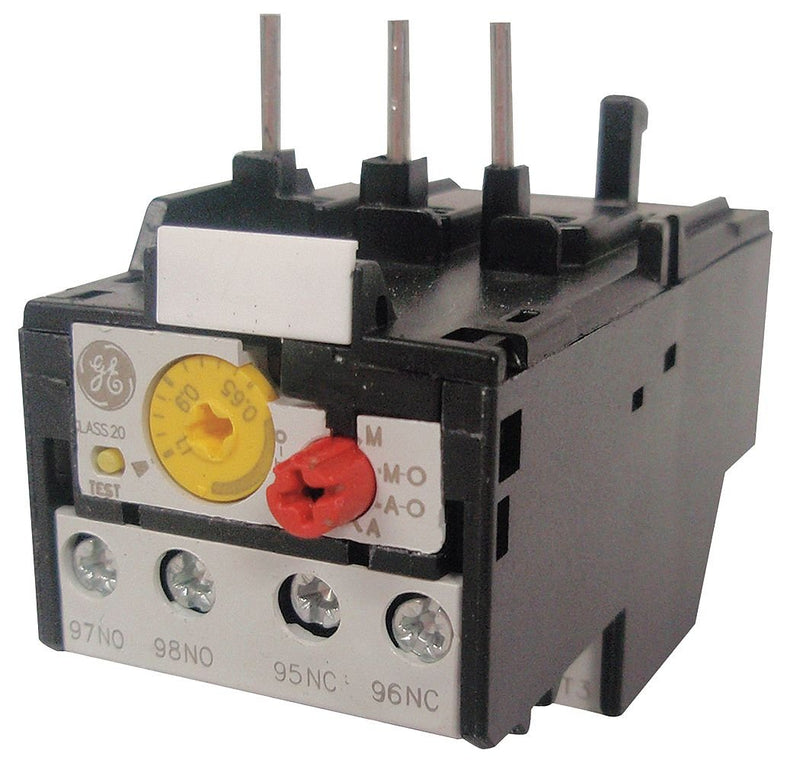
GE RT12N Overload Relay 8-12A 3-Pole
IEC-style Class 20 overload relay with 8–12A adjustable range and 3-pole protection for motor branch circuits.
$88.81*
View on Amazon
✓ In Stock on Amazon.com
*Price sourced from Amazon.com. Last updated:Aug 28, 2026.Price and availability are subject to change — details.
Affiliate Disclosure: As an Amazon Associate, Studio Supplies earns from qualifying purchases made through links on this page, at no additional cost to you. This helps support our editorial team.
Notice a mistake? Let Us Know
Overview
Specifications
Relay Type
IEC Style Thermal Overload Relay
Trip Class
20
Current Range
8.0 – 12.0A
Number of Poles
3
Reset Type
Auto / Manual (selectable)
Body Height
3.83"
Body Width
1.77"
Body Depth
2.08"
Brand
GE
Model
RT12N
Frequently Asked Questions
What is the adjustable current range of the RT12N, and does it require external calibration?
The RT12N is factory-calibrated for an 8.0–12.0A adjustment range. Field setting is performed via the onboard adjustment dial; no external calibration equipment is required for initial commissioning within this range.
What is the trip class of the RT12N, and what does that mean for motor protection?
Trip class is 20, meaning the relay will trip within 20 seconds at 7.2× the set current. Class 20 is appropriate for high-inertia loads such as conveyors and compressors where longer acceleration times are expected.
What is the full adjustment range, and how is the current set?
The RT12N is adjustable from 8.0A to 12.0A via a dial on the relay body. Set the dial to match the full-load amperage (FLA) of the protected motor as specified on the motor nameplate.
What Trip Class does the RT12N operate under, and what does that mean for motor protection response time?
The RT12N operates at Trip Class 20, meaning it will trip within 20 seconds at 7.2 times the set current under cold-start conditions. Class 20 is suited to higher-inertia loads that require a longer acceleration time before the relay distinguishes a motor starting surge from a genuine overload condition.
What reset modes are available, and can the relay be configured for automatic reset in unattended installations?
The RT12N supports both Auto and Manual reset modes. Auto reset enables the relay to self-clear after a trip event without operator intervention — appropriate for remote or unattended installations where restart delay is acceptable. Manual reset requires physical actuation, which is the preferred mode where a technician must verify the cause of the trip before restart.
Does the RT12N support both manual and automatic reset?
Yes. The relay provides selectable auto-reset and manual reset modes. Manual reset requires operator intervention after a trip event — the standard choice for safety-critical applications where unattended restart is undesirable.
Which contactor families is the RT12N designed to mount to?
The RT12N is designed for direct mounting to GE IEC-style contactors. Verify mechanical compatibility with your specific contactor model before procurement; a standalone base may be required in some panel configurations.
Is the RT12N compatible with standard IEC contactor mounting, and what are the body dimensions?
Yes — the RT12N is designed for direct mounting to IEC-style contactors. Body dimensions are 3.83" height × 1.77" width × 2.08" depth, which should be cross-referenced against the contactor block dimensions prior to procurement.
Is the RT12N a 3-pole device, and does it provide single-phase loss protection?
The RT12N is a 3-pole overload relay. Single-phase loss sensitivity should be confirmed against the full product datasheet, as this capability varies by relay series and is not explicitly stated in the base product description.
Is phase-loss protection included?
The relay monitors all three poles. An imbalance severe enough to constitute phase loss will produce sufficient differential current to trigger a trip event, providing practical phase-loss protection.
Related Products


