

Hal Leonard Corporation
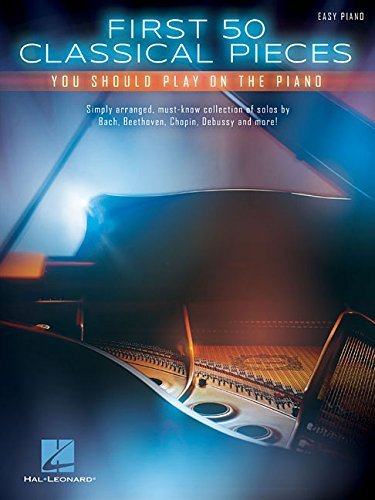
Hal Leonard Corporation First 50 Classical Pieces - Easy Piano
★★★★★
Fifty canonical works of the Western classical canon arranged accessibly for piano, making this Hal Leonard collection the most efficient entry point into serious repertoire study.
View price on Amazon
Affiliate Disclosure: Studio Supplies may earn a commission from qualifying purchases made through links on this page, at no additional cost to you. This helps support our editorial team.
Notice a mistake? Let Us Know
Overview
Embark on a Musical Journey with Classical Piano
The "First 50 Classical Pieces You Should Play on the Piano" is an essential songbook for pianists of all levels. This collection features 50 timeless classical compositions, arranged for easy piano, making them accessible to beginners while still capturing the essence of each piece. Dive into the world of classical music and master these must-know tunes.
- Title: First 50 Classical Pieces You Should Play on the Piano
- Arrangement: Easy Piano
- Publisher: Hal Leonard
- Publication Date: January 1, 2015
- Language: English
- Print Length: 141 pages
- Includes: Arabesque, Op. 100, No. 2; Ave Maria; Can Can; Canon in D; Clair de Lune; Eine Kleine Nachtmusik; Fur Elise; Hallelujah Chorus; Hungarian Dance No. 5; La Fille Aux Cheveux De Lin; Largo from Symphony No. 9; Meditation; Minuet in G; Ode to Joy; Pavane Pour Une Infante Defunte; Pomp and Circumstance; Sonata No. 11 in A Major; The Surprise Symphony; Waltz in A Minor; William Tell Overture; and more.
Pros & Cons
👍 Pros
- Repertoire selection spans nine centuries and eight major composers, giving a student genuine exposure to the stylistic breadth of Western classical music within a single volume
- Easy piano arrangements are editorially consistent in their difficulty calibration — the progression feels considered rather than arbitrary across the 50 selections
- Fingering annotations throughout reduce the research burden on self-teaching students who lack a teacher to prescribe hand positions
- At 141 pages for 50 complete arrangements, the page-per-piece ratio indicates full, playable versions rather than truncated or partial excerpts
- Publication from Hal Leonard — the dominant professional sheet music publisher — means print quality, notation typesetting, and paper stock meet standard performance grade
👎 Cons
- Arrangements of complex impressionist works (Clair de Lune, La Fille aux Cheveux de Lin) are necessarily reductive — listeners familiar with the originals will notice the harmonic and textural compromises
- The collection includes no audio reference recordings or QR-code playback links, leaving students without an authoritative listening guide embedded in the book
- Coverage is weighted toward Romantic and Baroque warhorses — 20th century and early modern composers are largely absent, creating a partial picture of the classical canon
- As a softcover publication, the book does not lay flat on a stand without bending the spine, which is a practical annoyance during practice sessions
- No difficulty grading or progression sequencing is provided — pieces are not ordered by challenge level, requiring the student or teacher to map their own learning path
Frequently Asked Questions
Is this collection genuinely useful for beginners, or is "easy piano" a marketing stretch?
The arrangements are legitimately beginner-accessible — simplified rhythms, reduced hand independence demands, and comfortable key signatures throughout. Pieces like Fur Elise and Ode to Joy are arranged to capture the melodic essence without requiring advanced technique. That said, a few selections (Clair de Lune, Canon in D) require modest intermediate facility to play musically, not just mechanically.
How does this edition handle pieces that are inherently complex, like Debussy's Clair de Lune?
Hal Leonard's arrangers make editorial compromises — arpeggiated left-hand figures are simplified to block chords, inner voices are omitted, and ornaments are removed. The arrangement captures the harmonic atmosphere and recognizable melody, but it is not a transcription of the original. Collectors seeking authentic editions should treat this as a pedagogical stepping-stone, not a performance edition.
Does this book include sheet music notation only, or are fingering markings and pedagogical notes included?
The arrangements include standard fingering suggestions throughout, which is particularly useful for self-teaching pianists navigating unfamiliar hand positions. Pedagogical commentary is minimal — this is a repertoire book, not a method book, so it pairs best with separate instructional material.
How does this collection compare to other Hal Leonard "First 50" titles in terms of repertoire depth?
This is one of the strongest entries in the First 50 series given the breadth of composers represented — Beethoven, Bach, Chopin, Debussy, Mozart, Handel, Brahms, Ravel, and more appear across the 50 selections. The editorial curation prioritizes recognizability and cultural weight, meaning most titles are pieces a student is likely to have heard before, which aids motivation.
At 141 pages for 50 pieces, how substantial are the individual arrangements?
Most arrangements run 2–4 pages, appropriate for the difficulty level. The page count reflects complete, musically satisfying versions of each work — not abbreviated two-page sketches. The physical book is a standard softcover trade publication, suitable for placement on a piano music stand.
Related Products


