



Hosa
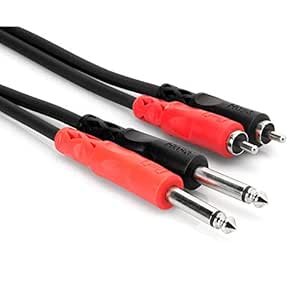
Hosa HOS CPR202 Dual 1/4" to RCA Interconnect Cable
Clean stereo signal routing for studio patch bays and live analog rigs — the Hosa CPR-202 bridges 1/4" TS and RCA without coloring your mix.
$9.46*
View on Amazon
✓ In Stock on Amazon.com
*Price sourced from Amazon.com. Last updated:Aug 30, 2026.Price and availability are subject to change — details.
Affiliate Disclosure: As an Amazon Associate, Studio Supplies earns from qualifying purchases made through links on this page, at no additional cost to you. This helps support our editorial team.
Notice a mistake? Let Us Know
Overview
Specifications
Cable Type
Interconnect Cable
Connector 1
Dual 1/4" TS
Connector 2
RCA
Brand
Hosa
Frequently Asked Questions
Does the CPR-202 carry a balanced signal or unbalanced?
Unbalanced. Both 1/4" TS and RCA connectors are inherently unbalanced, so this cable is suited for consumer-level gear, DJ mixers, and patch routing where impedance-matching isn't critical. For long runs or noise-sensitive environments, keep lengths short or use a DI box instead.
Will this introduce noise or signal degradation in a studio patch bay?
At 2 meters, noise pickup on an unbalanced run is minimal in a controlled studio environment. The CPR-202 is designed for short interconnect duty — patching between outboard units, routing from a mixer's RCA aux send to a recorder, or feeding a consumer amp from a pro mixer's insert point.
Can I use this to connect a DJ mixer's RCA outputs to a PA system's 1/4" inputs?
Yes, and it's a common use case. Just watch your levels — consumer RCA outputs run at -10 dBV while pro 1/4" inputs expect +4 dBu, so you may need to trim gain on the receiving end to avoid clipping.
Is this cable directional — does signal flow matter?
The cable passes signal in either direction, but in practice you'll want to plan your signal flow deliberately. Connecting a +4 dBu pro output to an RCA input designed for -10 dBV can overdrive the receiving device. Match levels at the source first.
What's the build quality like on the connectors?
The CPR-202 uses Hosa's standard molded connector housing. It's solid enough for studio rack patching and occasional live use, though it's not in the same tier as Mogami or Canare-terminated cables. For permanent installs, it's fine; for heavy-touring roadkits, consider a step up.
Related Products


