



Hoya
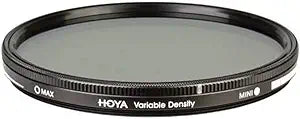
Hoya Y3VD055 55mm Variable Density Filter
★★★★★
From wide-open portraits to silky long exposures, the Hoya 55mm Variable ND gives you 1.5–9 stops of continuous exposure control in a single screw-in filter.
$69.90*
Check availability
*Price sourced from Amazon.com. Last updated:Jul 14, 2026.Price and availability are subject to change.
Affiliate Disclosure: Studio Supplies may earn a commission from qualifying purchases made through links on this page, at no additional cost to you. This helps support our editorial team.
Notice a mistake? Let Us Know
Overview
Key Features
Rotating filter ring with scale indicating max. through min. settings. Frame Material : Aluminum
Provides 1.5 - 9 stop exposure reduction, equal to filter factor NDX3 - NDX400
Enables slow shutter speeds to be used
Allows greater control over depth of field
Does not affect colour balance or detail
Specifications
Filter Size
55mm
Exposure Reduction
1.5 – 9 stops
ND Range
NDX3 – NDX400
Frame Material
Aluminum
Mount Type
Screw-in
Color Balance Effect
None
Pros & Cons
👍 Pros
- 1.5–9 stop range (NDX3 to NDX400) covers the full spectrum from mild exposure adjustment to long-exposure creative work without swapping filters
- Continuously variable adjustment via rotating ring allows real-time exposure tuning mid-shoot — especially valuable during changing natural light conditions
- Does not affect color balance, preserving neutral tones across the full density range without the warm or cool cast common on cheaper variable ND filters
- Aluminum frame construction is more durable and resistant to warping under temperature changes compared to plastic-framed alternatives
- 55mm screw-in mount makes installation and removal fast — no adapter rings or filter holder systems required
👎 Cons
- Like all variable ND filters using crossed polarizers, the X-pattern artifact appears at maximum density settings on wide-angle lenses — a physics limitation specific to this filter design
- Stacking additional filters with this variable ND increases the risk of vignetting, limiting combination filter workflows
- The added filter thickness from the rotating aluminum frame can cause vignetting on lenses shorter than 24mm even when used alone
- Stop markings on the rotating scale are approximate reference points, not calibrated values — exposure confirmation requires metering, not ring position alone
- At maximum density (9 stops / NDX400), autofocus reliability degrades in lower ambient light, requiring manual focus discipline from the shooter
Frequently Asked Questions
Can I use this filter for both video work and still photography?
Yes — the continuously variable adjustment makes it particularly well-suited to video, where you need to maintain a specific shutter angle (typically 180°) as lighting changes throughout the day. For still photography, it's equally useful for long-exposure work in bright conditions or for shooting wide-open in daylight. The single filter replaces carrying a set of fixed ND2, ND4, ND8, and ND400 filters.
Does rotating the filter ring cause any cross-polarization darkening at maximum density?
Like most variable ND filters, the S045080 uses two polarizing elements to achieve variable density — at maximum settings (approaching NDX400 / 9 stops), you may see the characteristic "X" pattern or dark cross artifact in wide-angle shots. This is a physics limitation of all variable ND designs, not a manufacturing defect. Keep this in mind when shooting wider than approximately 24mm at maximum density settings.
Will the 55mm thread fit my lens directly, and does it add noticeable vignetting?
This filter is threaded at 55mm and screws directly onto any lens with a 55mm front element thread. The aluminum frame adds filter thickness, which can cause vignetting on ultra-wide lenses or when stacking with other filters — especially noticeable in corners at focal lengths shorter than 24mm. On standard to telephoto focal lengths, vignetting is typically minimal.
How accurate is the stop scale printed on the rotating ring?
The scale provides a useful reference for repeatable settings — useful for matching exposure between shots or returning to a previously used density. However, like most variable ND scales, treat the markings as approximations rather than calibrated values. Confirm exposure with a meter or histogram rather than relying solely on the ring position.
Does this filter affect autofocus performance?
At lower density settings (1.5–4 stops), AF performance on most modern cameras is unaffected. At higher densities approaching 9 stops, the reduced light transmission can cause AF hunting in lower ambient light. In those conditions, setting focus before dialing up to maximum density, or switching to manual focus, will give you more reliable results.
Related Products


