



Hoya
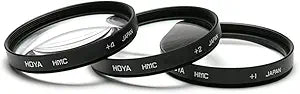
Hoya Y5NAHSET67 67mm Close-Up Lens Filter Kit
Transform any 67mm lens into a capable macro shooter — Hoya's HMC-coated +1, +2, and +4 close-up diopters stack for progressively tighter magnification without swapping to a dedicated macro lens.
$92.33*
View on Amazon
✓ In Stock on Amazon.com
*Price sourced from Amazon.com. Last updated:Aug 28, 2026.Price and availability are subject to change — details.
Affiliate Disclosure: As an Amazon Associate, Studio Supplies earns from qualifying purchases made through links on this page, at no additional cost to you. This helps support our editorial team.
Notice a mistake? Let Us Know
Overview
Key Features
HOYA Close-UP Lens-Kit +1/+2/+4: 1x Close-UP Lens +1, 1x Close-UP Lens +2, 1x Close-UP Lens +9
Depth-of-field is shallow so use as small an aperture as possible
CLOSE-UPs offer a world of new creativity
Specifications
Brand
Hoya
Model
Y5NAHSET67
Filter Thread Diameter
67mm
Diopter Strengths Included
+1, +2, +4
Quantity
3 filters
Coating
HMC (Hoya Multi Coating)
Type
Close-up lens filters (diopters)
Stackable
Yes
Frequently Asked Questions
What does the diopter number mean, and how do +1, +2, and +4 differ in practice?
Higher diopter numbers provide greater magnification by reducing the minimum focusing distance of your lens. The +1 gives subtle close-focus capability with minimal image impact; the +2 significantly compresses the focus distance; the +4 enables the tightest frame fill on small subjects. All three can be stacked for additive magnification.
Can these filters be stacked together for higher magnification?
Yes — mount the strongest diopter directly on the lens, then stack weaker ones behind it. Combining +1 and +4 yields approximately +5 total; all three together yields approximately +7. Stacking beyond two filters will introduce increasing edge softness and should be evaluated for your specific lens and subject.
Do close-up filters affect autofocus on the host lens?
Autofocus continues to operate, but the lens's effective focusing range is altered by the diopter — at higher strengths (+4), the camera can only focus at the very close distance determined by the filter. Shallow depth of field at these distances can cause AF to hunt on small or moving subjects.
Do these filters fit directly on a 67mm lens thread?
Yes — the Y5NAHSET67 kit is specifically sized for 67mm filter threads. Confirm your lens's front thread diameter (marked as ø67 or 67mm on the lens barrel) before purchasing; these will not fit 52mm, 58mm, 72mm, or 77mm lenses without a step-ring.
Does the HMC coating on these close-up filters reduce flare in macro shooting conditions?
Yes — HMC (Hoya Multi Coating) applies multiple anti-reflective layers to the filter glass, reducing surface reflections and contrast loss. This matters in close-up work where the lens is often positioned near a small, bright light source that would cause internal reflections in uncoated filter glass.
Related Products


