



Hoya
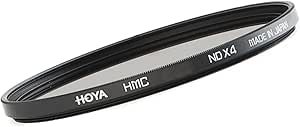
Hoya Y5ND4072 72mm 4X ND Multi Coated Filter
Two stops of light reduction on your 72mm lens — shoot wide open at noon or stretch shutter speeds for silky water and motion blur in bright conditions.
View price on Amazon
Affiliate Disclosure: As an Amazon Associate, Studio Supplies earns from qualifying purchases made through links on this page, at no additional cost to you. This helps support our editorial team.
Notice a mistake? Let Us Know
Overview
Key Features
Eliminates overly bright, washed-out images.
Balances exposures.
Increases control of depth of field.
Equally effective in color or black and white photography.
Multi Coated for flare prevention.
Specifications
Brand
Hoya
Model
Y5ND4072
Filter Type
Neutral Density (ND4)
Density
4X (0.6) — 2 stops
Diameter
72mm
Coating
Multi Coated
Application
Photography and videography
Frequently Asked Questions
What exposure effect does a 4X (ND4 / 0.6) filter actually produce in the field?
An ND4 reduces incoming light by 2 stops. In practical terms, if your metered exposure is 1/500s at f/5.6, attaching the ND4 allows you to slow to 1/125s — or open up to f/2.8 while maintaining the same shutter. For silky waterfall effects, two stops is a useful starting point. For complete motion blur in bright midday light, you'll want a denser ND8 or ND16.
Does the Hoya ND4 shift color balance when attached?
Neutral density filters are designed to reduce light without affecting color rendition. The Hoya ND4 with multi-coating performs well in this regard — color shift is minimal under most lighting conditions. Some slight warming can occur at the extreme edges of the exposure range, but for the vast majority of shoots it's undetectable without side-by-side comparison.
Will this filter cause vignetting on wide-angle lenses?
Vignetting risk increases with filter diameter and decreases with longer focal lengths. At 72mm on a standard zoom (e.g., a 24-70mm or 16-35mm), very wide angles may show corner darkening, particularly if stacking this ND with a polarizer or UV filter. On telephoto lenses 50mm and longer, vignetting is generally not a concern.
Is the multi-coating on this filter the same as Hoya's HD (high-definition) or Pro1D coating?
This is Hoya's standard multi-coating, not their higher-tier HD or Pro1D formulations. The multi-coating provides meaningful flare and ghost reduction over uncoated glass and performs reliably for most outdoor and studio work. Photographers shooting directly into light sources or requiring maximum flare suppression may find the HD-series coating more resistant under those specific conditions.
How should I clean the ND4 filter to avoid scratching the coating?
Use a blower brush first to remove loose particles, then a clean microfiber cloth with lens cleaning solution applied to the cloth — never directly to the glass. Avoid paper tissues or shirt fabric, which can micro-scratch the coating over time. The filter's multi-coating is durable but not impervious to abrasive contact.
Related Products


