

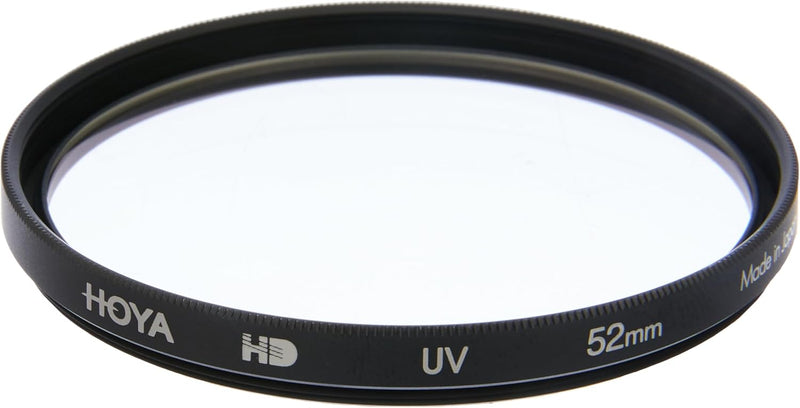


Hoya
Hoya YHDUV052 52mm HD UV Hardened Multi-Coated Filter
Keep UV haze out of your outdoor shots and your front element intact — the Hoya HD UV's hardened glass holds up where standard filters won't.
$38.52*
Check availability
*Price sourced from Amazon.com. Last updated:Aug 28, 2026.Price and availability are subject to change — details.
Affiliate Disclosure: As an Amazon Associate, Studio Supplies earns from qualifying purchases made through links on this page, at no additional cost to you. This helps support our editorial team.
Notice a mistake? Let Us Know
Overview
Key Features
Eliminates haze.
Serves as a lens protector.
Hardened optical glass.
4 times the breaking strength.
8 Layer Waterproof Multi-Coating.
Specifications
Filter Size
52mm
Glass Type
Hardened Optical Glass
Breaking Strength
4× standard optical filter glass
Coating
8-Layer Waterproof Multi-Coating
Light Transmission
99.35% (400–700nm)
Water Resistance
Waterproof
Filter Type
UV (Ultraviolet)
Frequently Asked Questions
Will this filter cause any noticeable loss of sharpness or contrast with a sharp prime lens?
With 99.35% light transmission and multi-coated hardened optical glass, the Hoya HD UV is engineered to add negligible optical degradation. In practice, you won't see a measurable difference in sharpness or micro-contrast compared to shooting without filtration — the multi-coating controls surface reflections that can introduce the flare and contrast loss associated with cheaper UV filters. On lenses sharper than the filter's optical quality threshold, some photographers shoot without any filter for maximum fidelity, but for the overwhelming majority of shooting situations the HD UV is optically transparent in effect.
How does the hardened glass on the HD UV compare to standard filter glass for scratch resistance?
Hoya rates the HD UV glass at four times the breaking strength of standard optical filter glass. In handling terms, this means the filter surface resists the light scratches and abrasions from lens cleaning cloths and accidental contact that gradually degrade standard filter coatings over months of use. It's not scratch-proof, but it is meaningfully more resilient — you'll get significantly longer useful life from the HD UV before cleaning-induced micro-scratches start affecting image quality.
Does the 8-layer waterproof coating affect how I clean the filter?
The waterproof coating causes water, dust, and fingerprint oils to bead and release rather than bond to the surface, which makes field cleaning faster and requires fewer passes with a cleaning cloth — reducing the cumulative wear on the coating surface. Clean with a microfiber cloth or lens pen as you would any coated optical surface; avoid paper products or rough cloths regardless of the coating quality.
Will this 52mm filter fit my lens, and does the filter ring add meaningful focus breathing or vignetting on wide-angle lenses?
The 52mm thread size is the key compatibility spec — confirm your lens's front filter thread size (printed on the lens cap or barrel, often preceded by a ⌀ symbol) matches 52mm before ordering. On lenses shorter than approximately 18mm full-frame equivalent, even slim-ring UV filters can introduce vignetting in corners; the HD UV uses a standard-profile ring, so on wide-angle lenses at their shortest focal length you should check for corner falloff before committing it to regular use.
Can this filter stay on the lens during outdoor shoots in rain or dusty conditions?
That's one of its primary design purposes. The waterproof multi-coating repels moisture and dust accumulation on the front surface, and the hardened glass is more resistant to the micro-abrasions that windblown grit causes on softer filter glass. It functions as a first line of defense for the front element in the field — the filter is far easier and cheaper to replace than a scratched front lens element.
Related Products


