
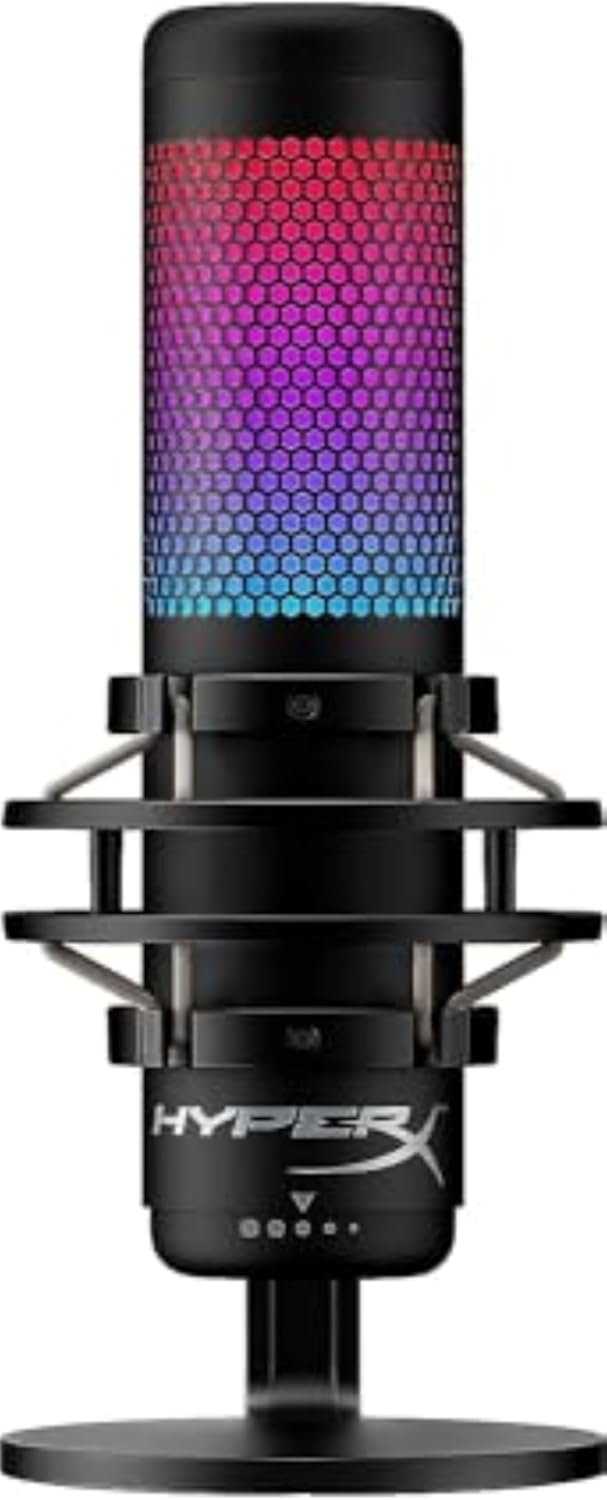


HyperX QuadCast S RGB USB Condenser Microphone — Editorial Review
The HyperX QuadCast S (HMIQ1S-XX-RG/G) is HyperX's RGB-illuminated USB condenser microphone targeted at gamers, streamers, podcasters, and content creators on Twitch / YouTube / Discord. Per HyperX's product specifications, the microphone uses three 14mm electret condenser capsules selectable between four polar patterns (cardioid, omnidirectional, stereo, bidirectional) via a rotary dial, 48 kHz / 16-bit USB audio, 20 Hz - 20 kHz frequency response, built-in anti-vibration shock mount + internal pop filter, integrated 3.5 mm headphone monitor jack with zero-latency monitoring, and dynamic dual-RGB lighting customizable via HyperX NGENUITY software. The findings below aggregate independent coverage from Tom's Guide and SoundGuys.
Tom's Guide on the Value Proposition
Tom's Guide's HyperX QuadCast S review characterizes the microphone as "a great microphone for streamers and content creators, with high sound quality, reliable build and customizable RGB lighting." The publication specifically notes that the built-in shock mount and internal pop filter help the QuadCast S rival the legendary Blue Yeti in sound quality — an important framing for streamers comparison-shopping in the $130-$170 USB-mic tier.
SoundGuys — Sound Quality Assessment
SoundGuys' QuadCast S review provides measurement-driven coverage. The frequency response is characteristic of mid-tier electret condenser USB microphones — capable of capturing the full vocal frequency range without aggressive coloration, suitable for streaming and conversational podcasting workflows.
Four Polar Patterns — When Each Matters
Per HyperX's product specs, the QuadCast S offers four selectable polar patterns via rotary dial. Practical use cases:
- Cardioid (default): Single user facing the mic — gaming streams, solo podcasts, voice-only YouTube videos. The most common use case
- Omnidirectional: Multi-person conversations around the mic — small in-person group recordings, conference-room ambient capture. Off-axis rejection is sacrificed
- Stereo: Spatial audio capture for ASMR creators and music recording where left-right separation matters
- Bidirectional (figure-8): Two-person face-to-face interview at one mic — the classic radio-interview pattern. Rejects sound from the sides while capturing front and back
Built-In Pop Filter + Shock Mount
Both Tom's Guide and SoundGuys highlight the integrated pop filter and anti-vibration shock mount as practical advantages over USB mics that require external add-on accessories. For streamers who want a desk-mounted mic with no additional hardware purchases, the QuadCast S ships ready-to-record. The internal pop filter handles plosives (P, B, T) without requiring an external mesh screen between the speaker and the mic.
The Mute-by-Tap Feature
The top of the mic doubles as a touch-sensitive mute button — tap to toggle mute, with the RGB lighting visually indicating active vs muted state. This is a meaningful workflow convenience for streamers and podcasters who need to mute / unmute quickly during a recording session without alt-tabbing to software controls.
Where the QuadCast S Specifically Fits
- Gaming streamers on Twitch / YouTube Gaming / Kick — the canonical use case. Tom's Guide-rated "great for streamers and content creators"
- Solo / co-host podcasters on USB-only workflow — eliminates the audio interface + XLR microphone chain
- Discord voice-chat gamers wanting broadcast-quality voice without an XLR signal chain
- YouTube creators producing voiceover-driven content (educational, commentary, reviews) at home
- Aesthetic-conscious desk setups where the RGB lighting matches a broader gaming-PC aesthetic
- First-time USB mic buyers who want a complete out-of-box experience (shock mount + pop filter + multiple polar patterns + headphone monitor + RGB)
Honest Limits Buyers Should Know
- USB-only — no XLR output. When the buyer eventually upgrades to an XLR + interface workflow, the QuadCast S doesn't migrate to the new chain (sells second-hand or becomes a backup mic). XLR + interface workflows have a higher ceiling for audio quality and signal-chain flexibility
- 16-bit / 48 kHz audio depth. Per HyperX's spec, the USB audio is 16-bit. Higher-end USB mics (Shure MV7+ Plus at 24-bit / 48 kHz, Rode NT-USB+ at 24-bit) offer more dynamic range headroom for post-production normalization and processing. For typical streaming consumption (1080p YouTube, Twitch chat), 16-bit is functionally adequate
- RGB lighting may not match all aesthetic priorities. The QuadCast S's RGB illumination is a feature for many buyers but a distraction or visual conflict for others. Buyers who want a understated desk aesthetic should consider Shure MV7 / MV7+ (matte black professional finish) or Rode NT-USB+ instead
- Touch-mute can be triggered accidentally. Users moving around the mic during sessions can accidentally tap-mute. Some streamers prefer a hardware mute switch or software-based mute hotkey
- Condenser sensitivity picks up room noise. Unlike a dynamic mic (SM7B, SM58), the QuadCast S's condenser pickup catches HVAC, computer fans, keyboard typing, and room reverb at higher levels. For untreated home spaces with significant background noise, a dynamic alternative (Shure MV7+, Samson Q2U) may produce cleaner results
- QuadCast 2 S successor is available. HyperX has released the QuadCast 2 S as the next-generation model. Buyers should price-compare both — if the QuadCast 2 S is available at similar pricing, the newer model is the better value
Where Buyers Should Look Elsewhere
- Untreated rooms with significant noise → Shure MV7+ (USB + XLR hybrid, dynamic, podcast-tuned), Rode PodMic USB
- Maximum audio quality investment paths → XLR dynamic mic (Shure SM7B, Electro-Voice RE20) + audio interface (Focusrite Scarlett 2i2, Mackie ProFX10v3+)
- Live music vocal performance → Shure SM58 / Beta 58A — completely different category
- Professional studio voiceover → large-diaphragm XLR condenser (Neumann TLM 103, Rode NT1) + treated room + interface
- Most current HyperX generation → HyperX QuadCast 2 S — if priced similarly, the newer model is the better value
Sources & Citations
- HyperX, "QuadCast 2 S RGB USB Microphone product page (current generation; covers QuadCast S architecture)," hyperx.com (accessed 2026-05-18)
- Tom's Guide, "HyperX QuadCast S microphone review," tomsguide.com (accessed 2026-05-18)
- SoundGuys, "HyperX QuadCast S review," soundguys.com (accessed 2026-05-18)
Last verified: 2026-05-18


