



IK Multimedia
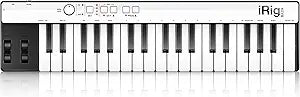
IK Multimedia IP-IRIG-KEYS-IN iRig KEYS 37-Key MIDI Controller
Three octaves of velocity-sensitive keys in a bus-powered package that connects to iOS or USB without a driver install.
Check availability
Affiliate Disclosure: As an Amazon Associate, Studio Supplies earns from qualifying purchases made through links on this page, at no additional cost to you. This helps support our editorial team.
Notice a mistake? Let Us Know
Overview
Key Features
37 velocity-sensitive mini-keys (3 full octaves range plus one note)
Core MIDI (iOS) and USB class compliant (Mac/PC) - plug and play
Powered from the iOS device or Mac/PC USB
Comes with SampleTank FREE iOS and iGrand Piano FREE apps (download from the App store)
Comes with free Mac/PC virtual instrument: SampleTank 2 L (download from IK User Area)
Specifications
Keys
37 velocity-sensitive mini keys (3 octaves + 1 note)
Connectivity
Lightning (iOS), USB (Mac/PC)
Power
Bus-powered (iOS device or USB)
MIDI Protocol
Core MIDI (iOS), USB Class Compliant (Mac/PC)
Controls
Pitch bend wheel, modulation wheel, expression/sustain pedal input (TRS)
Onboard Audio
None (MIDI controller only)
Included Software
SampleTank FREE (iOS), iGrand Piano FREE (iOS), SampleTank 2 L (Mac/PC download)
Frequently Asked Questions
Does the iRig Keys require a separate power supply, audio interface, or driver installation?
No on all three counts. The keyboard draws power directly from the connected iOS device's Lightning port or from USB bus power on Mac/PC. It is USB class compliant on Mac/PC — plug in and it appears as a MIDI device in your DAW immediately. iOS connectivity uses Core MIDI, which is native to iOS without any app installation for MIDI routing.
How does the iRig Keys transmit MIDI data — does it have audio output?
The iRig Keys is a pure MIDI controller — it transmits note on/off, velocity, pitch bend, modulation, and CC data only. It has no audio output, no onboard sound engine, and no audio interface circuitry. Sound generation happens entirely in the connected app or DAW.
Are the 37 keys full-size or mini keys, and how does that affect playability?
These are mini keys — smaller than standard piano-width keys. The 37-key span covers 3 full octaves plus one note, which is a practical range for melody, chord voicing, and basic two-hand playing. Players accustomed to full-size weighted or semi-weighted piano keys will notice the reduced key width immediately; technique adapts but is not equivalent to a standard-width keyboard.
What MIDI channels and CC messages can be transmitted from the iRig Keys?
The iRig Keys transmits on MIDI channel 1 by default and supports standard note velocity, pitch bend wheel, and modulation wheel messages. It also accepts an expression/sustain pedal input (TRS, pedal sold separately) for additional CC transmission. There are no programmable pads, knobs, or faders — MIDI output is limited to the onboard controls.
Does the iRig Keys work with iPad and iPhone simultaneously as a MIDI clock source?
It functions as a MIDI controller connected to one device at a time via Lightning or USB — it does not split signal to multiple hosts simultaneously. As a Core MIDI device on iOS, it can be used as a MIDI input source by any app on the connected device that supports Core MIDI, including DAWs that distribute MIDI internally between apps using Ableton Link or AudioBus.
Related Products


