



IK Multimedia
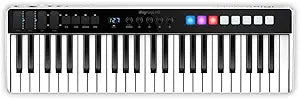
IK Multimedia IP-IRIG-KEYSIO49-IN Portable MIDI Keyboard Controller
★★★★★
48Vphantom power
49-key MIDI controller with integrated 24-bit/96kHz audio interface for full-range portable music production.
$176.60*
View on Amazon
✓ In Stock on Amazon.com
*Price sourced from Amazon.com. Last updated:Jun 04, 2026.Price and availability are subject to change.
Affiliate Disclosure: Studio Supplies may earn a commission from qualifying purchases made through links on this page, at no additional cost to you. This helps support our editorial team.
Notice a mistake? Let Us Know
Overview
Key Features
FULLY PORTABLE: Compact and lightweight, this high-quality MIDI keyboard with a 24-bit/ 96 Khz capable I/O audio interface is an all-in-one studio that works seamlessly with iPhone, iPad, Mac and PC.
VELOCITY-SENSITIVE: Immerse yourself in the music. With 49 full-size keys and a smooth, velocity-sensitive synth-action keyboard, you'll find it easy to play and compose music anywhere.
COMPREHENSIVE CONTROLS: Compact and complete, the MIDI keyboard controller has two slider strips for pitch and modulation (user programmable), octave, Program change and transport controls.
MAIN FEATURES: Includes a premium combo input jack with gain control for line, instrument or microphones with 48V phantom power and balanced stereo and headphone outputs.
COMPATIBLE WITH: Requires iOS 12 or later, iPhone 5 a newer, iPad 4th Generation and newer, macOS 10.6 or later, and Windows with an installed driver.
Specifications
Brand
IK Multimedia
Model
IP-IRIG-KEYSIO49-IN
Keys
49 Full-Size, Velocity-Sensitive
Key Action
Synth-Action
Audio Interface
24-bit / 96 kHz
Controls
2 Slider Strips (Pitch/Modulation, user programmable), Octave, Program Change, Transport
Input
Combo Input Jack (Line/Instrument/Microphone) with Gain Control
Phantom Power
48V
Outputs
Balanced Stereo, Headphone
Compatibility
iOS 12+, iPhone 5+, iPad 4th Gen+, macOS 10.6+, Windows (with driver)
Pros & Cons
👍 Pros
- 49 full-size velocity-sensitive keys provide a four-octave range suitable for two-handed playing and piano parts
- Integrated 24-bit/96kHz audio interface with combo input eliminates the need for a separate recording interface
- 48V phantom power on the input supports condenser microphones directly
- Pitch and modulation slider strips plus transport controls offer hands-on DAW interaction
- Cross-platform compatibility with iOS, macOS, and Windows accommodates diverse studio setups
👎 Cons
- Larger 49-key footprint reduces portability compared to 25-key compact controllers
- Slider strips for pitch and modulation are less tactile and precise than traditional pitch wheels
- No drum pads or rotary knobs limits hands-on control for beat-making and mixing tasks
- Windows requires a separate driver installation for operation
- No standalone sound generation—requires a connected device and software to produce audio
Frequently Asked Questions
How does the 49-key version differ from the 25-key iRig Keys I/O?
The iRig Keys I/O 49 offers 49 full-size keys instead of 25, providing a four-octave range that is better suited for two-handed playing, piano parts, and performances that require wider reach, while retaining the same audio interface and control features.
Can I record vocals and play MIDI instruments simultaneously with this controller?
Yes, because the iRig Keys I/O 49 combines a MIDI keyboard and a 24-bit/96kHz audio interface with a combo input jack, you can play virtual instruments via MIDI while recording a vocal or instrument through the audio input in a single session.
Does the combo input support condenser microphones?
Yes, the combo input provides 48V phantom power, so you can connect condenser microphones directly without needing an external power supply or separate interface.
Is the iRig Keys I/O 49 bus-powered?
When connected to a Mac or PC via USB, it draws power from the host device. Power requirements may vary when used with iOS devices depending on the connection method.
What software compatibility does this controller have?
It works with any MIDI-compatible DAW or music app on iOS 12+, macOS 10.6+, and Windows (with driver installed), including popular options like GarageBand, Logic Pro, Ableton Live, and FL Studio.
Related Products


