



IK Multimedia
IK Multimedia IP-ZTONE-DI-IN Z-Tone DI Instrument Preamp & DI Box
Shape your guitar and bass tone at the source with switchable JFET warmth, variable impedance, and studio-grade DI output
View price on Amazon
Affiliate Disclosure: As an Amazon Associate, Studio Supplies earns from qualifying purchases made through links on this page, at no additional cost to you. This helps support our editorial team.
Notice a mistake? Let Us Know
Overview
Key Features
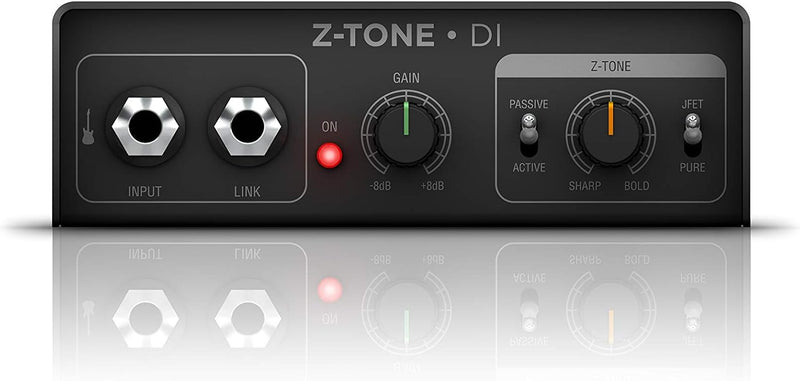
ADVANCED DIRECT BOX: Z-TONE DI is a next-level direct box / reamp tool, letting you easily connect your audio interface to your guitar amp or guitar pedals.
ACTIVE/PASSIVE PICK-UP SELECTOR: Match pickup types with your guitar or bass to ensure the best possible tone from both active pickups and passive pick-ups
SWITCHABLE CHANNELS: Choose between PURE ultra-linear, transparent sound quality, and a JFET for warm, tube-like guitar tone
Z-TONE CIRCUIT: Built with a Z-TONE impedance-adapting circuit, to help you get a wider range of tones from any single guitar or bass
GROUND LOOP LIFT: This high-quality guitar preamp features a ground-lift switch that eliminates noise and hum for capturing crystal clear sound.
Specifications
Type
Instrument Preamp / Direct Box / Reamp Box
Channels
Switchable PURE (ultra-linear) / JFET (tube-like)
Pickup Selector
Active / Passive
Impedance Control
Z-TONE variable impedance
Outputs
Balanced XLR, Unbalanced 1/4", Link out
Ground Lift
Switchable
Power
9V battery or +48V phantom power
Construction
Rugged metal housing
Frequently Asked Questions
What is the difference between the PURE and JFET channels on the Z-Tone DI?
The PURE channel provides an ultra-linear, transparent signal path that passes your instrument's tone with minimal coloration — ideal for clean DI tracks you plan to reamp or process in a DAW. The JFET channel introduces harmonic saturation that emulates tube-stage warmth, adding even-order harmonics and slight compression that fatten a guitar or bass signal before it hits your interface.
How does the Z-TONE impedance control affect the sound?
Variable impedance loading changes how your pickups interact with the input stage. Lower impedance settings roll off high-frequency content and tighten the low end, producing a darker, thicker tone. Higher impedance settings let the full frequency response of your pickups through, resulting in a brighter, more open sound. This gives you tonal range from a single instrument without swapping pickups.
Can the Z-Tone DI run on phantom power instead of a battery?
Yes, the Z-Tone DI operates on either a 9V battery or +48V phantom power supplied through the balanced XLR output. Phantom power from your interface or mixer eliminates battery dependency entirely, which is preferable for extended studio sessions.
Does the active/passive pickup selector matter if I only play passive guitars?
Yes — leaving the selector on the correct setting optimizes the input impedance and gain staging for your pickup type. Using the passive setting with passive pickups ensures proper impedance matching that preserves your instrument's natural resonance and output level. Setting it to active when using passive pickups would result in a weaker, thinner signal.
Can I use the Z-Tone DI as a reamp box?
The Z-Tone DI functions as a reamp tool by sending a recorded DI signal from your interface back through the unit and out to a guitar amplifier or pedalboard via the Link output. This lets you re-record through real amps after tracking, with the JFET channel and Z-TONE control still available in the reamp chain.
Related Products


