JVC

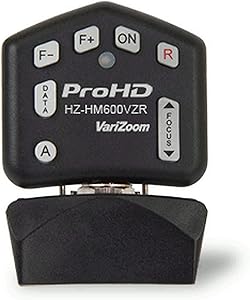
JVC HZ-HM600VZR Remote Lens Control - GY-HM600/650 Cameras

3.7 (2 reviews)

The JVC HZ-HM600VZR puts smooth zoom, focus, and iris control at a remote operator's fingertips on GY-HM600/650 tripod, jib, and crane setups.

$399.00*
Check availability

*Price sourced from Amazon.com. Last updated:Jul 14, 2026.Price and availability are subject to change.

Affiliate Disclosure: Studio Supplies may earn a commission from qualifying purchases made through links on this page, at no additional cost to you. This helps support our editorial team.

Notice a mistake? Let Us Know

Overview

The JVC HZ-HM600VZR Remote Lens Control is a dedicated camera control unit engineered for the GY-HM600 and GY-HM650 cameras in tripod, jib, and crane production configurations. It connects via a 2.5mm LANC serial interface and provides real-time remote control of the four functions that define camera operation from a remote position: zoom speed and direction, focus, iris, and record start/stop. For jib and crane setups, this controller is not an accessory — it is a production requirement. Without remote lens control, a camera mounted on a crane arm or elevated jib requires a camera assistant physically at the lens or pre-set zoom and focus that cannot be adjusted during the shot. The HZ-HM600VZR eliminates that constraint, giving a ground-based operator full creative control over the camera's optical state in real time.

The LANC interface is a low-overhead serial protocol that delivers control commands with negligible latency — the operator's zoom and focus inputs translate to camera response without the wireless signal processing delay that Bluetooth or Wi-Fi based controllers introduce. This matters in live production contexts where a slow focus pull or zoom hesitation is a visible artifact in the final output. The controller is lightweight and sized for handheld operation by a dedicated focus puller or mounting at the pan bar position. For productions running the GY-HM600/650 as their primary field cameras, the HZ-HM600VZR is the correct, camera-native lens control solution — compact, wired, and operationally straightforward in configurations where complexity is the enemy of clean production execution.

Key Features

REMOTE LENS CONTROL FOR GY-HM1

Specifications

Brand
JVC
Model Number
HZ-HM600VZR
Device Type
Remote Lens Control
Compatible Camera
JVC GY-HM600
Compatible Camera
JVC GY-HM650
Listed Compatibility
JVC GY-HM1
Product Category
Pro Video Accessory

Pros & Cons

👍 Pros

  • Remote zoom, focus, iris, and record start/stop control are consolidated in a single unit — providing the full operational lens control set required for unattended tripod positions and elevated jib/crane rigs without additional accessories.
  • LANC connectivity is a standardized, low-latency serial interface — control response is immediate and reliable without the wireless pairing overhead or signal dropout risk of wireless remote systems.
  • Designed specifically for the GY-HM600 and GY-HM650, the HZ-HM600VZR's control mapping is camera-native — no generic lens control system calibration or parameter mapping required at setup.
  • Record start/stop inclusion enables a single remote operator to manage both lens state and recording state — eliminating the need for a separate record trigger on crane or jib configurations.
  • Compact controller form factor allows it to be handheld by a focus puller or mounted to a tripod handle position without adding significant weight or rig complexity to the camera support system.

👎 Cons

  • Compatibility is locked to the GY-HM600 and GY-HM650 — productions that operate a mixed JVC fleet or upgrade to newer JVC body generations cannot reuse this controller without confirming protocol compatibility, which is not guaranteed.
  • The 2.5mm LANC interface is a legacy serial connector — cable extensions and inline connectors for this format are available but are not as widely stocked as standard production cabling, which can create procurement friction on tight-turnaround productions.
  • No wireless option exists in this unit — cable routing from the controller position to the camera must be planned for each rig configuration, which adds setup time on complex crane and jib rigs where cable management is already demanding.
  • Product documentation does not specify cable length or operating range — buyers planning specific jib height or crane boom extensions need to confirm reach specifications before committing to this unit for a fixed installation.
  • Single-camera compatibility means the HZ-HM600VZR is a dedicated accessory, not a shared asset — multicamera productions with multiple GY-HM600/650 bodies require one unit per camera.

Frequently Asked Questions

The HZ-HM600VZR is designed for the JVC GY-HM600 and GY-HM650 cameras. It is not a universal remote lens controller — it uses the camera's specific control protocol and connector, and compatibility outside the GY-HM600/650 pair should not be assumed without JVC confirmation.
The unit provides remote control of zoom, focus, iris, and record start/stop. This covers the primary lens and recording functions an operator needs for unattended or remote-position camera operation — no secondary panel or additional wiring is required for these functions.
The controller uses a 2.5mm LANC connector. LANC (Local Application Control Bus System) is Sony's serial control protocol, adopted by JVC on this camera series. The 2.5mm LANC jack is a standard physical interface on compatible cameras.
Yes — remote lens control is the defining use case for crane and jib-mounted cameras where the operator cannot physically access the camera lens. The HZ-HM600VZR allows a ground-positioned operator to manage zoom, focus, and iris while the camera is elevated, providing the production control equivalent of a camera assistant at the lens position.
Product documentation specifies the 2.5mm LANC connector interface but does not detail the included cable length or operating range in the available product information. Confirm cable length and any extension compatibility with JVC or the seller before purchase for installations requiring specific reach distances.