

Kramer
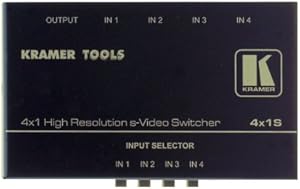
Kramer 4X1S 4X1 Y/C Mechanical Switcher
Enhance Your Video Switching with PrecisionIntroducing the Kramer 4X1S Y/C Mechanical Switcher, designed for high-performance switching of S-Video signals without the need for external power. This compact unit allows you to seamlessly route one of four S-Video inputs to a single output, making it...
$49.00*
Check availability
*Price sourced from Amazon.com. Last updated:Aug 28, 2026.Price and availability are subject to change — details.
Affiliate Disclosure: As an Amazon Associate, Studio Supplies earns from qualifying purchases made through links on this page, at no additional cost to you. This helps support our editorial team.
Notice a mistake? Let Us Know
Overview
Enhance Your Video Switching with Precision
Introducing the Kramer 4X1S Y/C Mechanical Switcher, designed for high-performance switching of S-Video signals without the need for external power. This compact unit allows you to seamlessly route one of four S-Video inputs to a single output, making it an ideal choice for professional video applications.
Specifications
- Signal Type: S-Video (Y/C)
- Bandwidth (Y): 400MHz (-3dB)
- Switching Type: Mechanical (Passive)
- Power Requirement: None
- Form Factor: Compact Kramer TOOLS; 3 units can be rack-mounted side-by-side in a 1U rack space with the optional RK-3T rack adapter.
Specifications
Brand
Kramer
Model
4X1S
Inputs
4
Outputs
1
Signal Type
Y/C (S-Video)
Switching Type
Mechanical
Frequently Asked Questions
Can this Kramer switcher be used with composite video signals?
No, this Kramer 4X1S switcher is specifically designed for Y/C (S-Video) signals and will not be compatible with composite video.
Does the Kramer 4X1S switcher require external power to operate?
The listing indicates a mechanical switcher, which typically does not require external power as the switching is done physically, but it's always good to verify.
What is the maximum resolution supported by this Y/C mechanical switcher?
This switcher handles analog Y/C signals, which do not have a "resolution" in the digital sense, but are generally associated with standard definition video quality.
Can this switcher be rack-mounted for use in a production rack?
The product description does not specify rack-mounting capabilities; users would need to check the physical dimensions and any available mounting accessories.
Will this Kramer 4X1S switcher introduce any signal loss or degradation?
As a mechanical switcher, it aims to minimize signal degradation, but all analog connections can be susceptible to some level of loss; a well-maintained cable run is crucial.
Is this switcher suitable for live production environments where quick transitions are needed?
The mechanical nature means transitions are manual and may not be as instantaneous or seamless as electronic switchers, potentially causing a brief signal interruption.
Related Products


