



Leica
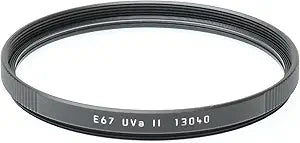
Leica E67 67mm UVa II Filter - Black
Protect your Leica glass without sacrificing a pixel — the E67 UVa II filter delivers optically neutral UV protection built to Leica's exacting standards.
View price on Amazon
Affiliate Disclosure: As an Amazon Associate, Studio Supplies earns from qualifying purchases made through links on this page, at no additional cost to you. This helps support our editorial team.
Notice a mistake? Let Us Know
Overview
Specifications
Filter Type
UVa II
Filter Size
67mm
Color
Black
Frequently Asked Questions
Will the Leica E67 UVa II filter affect image sharpness or color rendition on Leica lenses?
Leica-manufactured filters are ground and coated to tolerances matched to their own optics. The UVa II is designed to be optically neutral — no measurable shift in color rendering, no degradation of micro-contrast or edge sharpness that you'd notice in actual image output, even when shooting wide open.
Does leaving a UV filter on permanently create any optical drawbacks?
The primary risk with any filter is flare and ghosting in high-contrast backlit scenes, and introducing an additional air-glass surface. The Leica UVa II's multi-coating mitigates this meaningfully, but photographers shooting directly into strong light sources may still want to remove it in those specific conditions.
Is the E67 designation a Leica-specific sizing system, or does it correspond to standard 67mm filter threads?
E67 is Leica's internal designation for a 67mm filter thread — it is a standard 67mm filter size and fits any lens with a 67mm front filter thread from any manufacturer, though it is optimized as a companion to Leica's own 67mm-threaded lenses.
Does the E67 UVa II provide meaningful UV protection for digital sensor shooting, or is it primarily for lens protection?
Modern digital sensors are largely insensitive to UV light, so the UV-blocking function has minimal impact on digital images. On a Leica system, the UVa II's primary practical value is physical lens protection — shielding the front element from dust, moisture, fingerprints, and accidental contact without altering the image.
How does the Leica E67 UVa II compare to third-party 67mm UV filters at lower price points?
The Leica filter commands a premium that reflects its multi-coating quality and frame construction. In controlled optical testing, top-tier third-party filters can perform comparably, but for photographers who have invested in Leica glass, the assurance of matched optical tolerances and Leica's quality control carries practical value beyond spec-sheet equivalence.
Related Products


