



LG
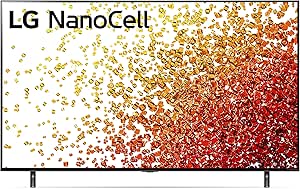
LG 55NANO90UPA 55" NanoCell 4K UHD Smart TV (2021)
★★★★★
4KUHDHDR
LG's NanoCell 4K panel with a7 Gen 4 AI processing and a true 120Hz refresh rate brings cinematic color accuracy and smooth gaming performance to the 55" living room screen.
Check availability
Affiliate Disclosure: Studio Supplies may earn a commission from qualifying purchases made through links on this page, at no additional cost to you. This helps support our editorial team.
Notice a mistake? Let Us Know
Overview
Key Features
REAL 4K NANOCELL DISPLAY: Bring your favorite shows to life with a billion rich colors. Get deep blacks and enhanced contrast for a more detailed picture with Full Array Dimming.
A7 GEN 4 AI PROCESSOR 4K: Catch every detail with the smooth, crisp picture brought to you by our a7 Gen 4 AI Processor 4K. It adjusts your viewing and audio settings automatically with AI Picture and AI Sound, while AI 4K Upscaling authentically calibrates every scene.
HOME CINEMA EXPERIENCE: Get breathtaking picture and audio that makes you feel like you're in the action with Cinema HDR, Dolby Vision IQ and Dolby Atmos. See movies exactly how directors intended with Filmmaker Mode. And with built-in access to Netflix, Prime Video, Apple TV plus, Disney plus and LG channels, your favorite content is at your fingertips.
ULTIMATE GAMEPLAY: Stay a step ahead, where milliseconds make all the difference. FreeSync Premium Compatible for real-time action and virtually no tearing coupled with fluid 120Hz refresh rate. Game Optimizer gives you easier access to all your game settings, while the latest HDMI delivers a fast connection. Plus, you'll get low input lag and fast response times with Auto Low-Latency Mode and HGiG.
GOOGLE ASSISTANT AND ALEXA BUILT IN: There’s no need for an extra device – just ask your TV for music, weather, news, your Amazon shopping list, and more. Plus, conveniently control your connected home and smart devices.
Specifications
Screen Size
55 inches
Resolution
4K UHD (3840x2160)
Panel Technology
NanoCell
Processor
a7 Gen 4 AI Processor 4K
Refresh Rate
120Hz
HDR Support
Cinema HDR, Dolby Vision IQ, HDR10, HLG
Audio
Dolby Atmos
Smart Platform
webOS
Voice Assistants
Google Assistant, Amazon Alexa (built-in)
Gaming Features
FreeSync Premium, ALLM, Game Optimizer, HGiG
Model
55NANO90UPA
Year
2021
Pros & Cons
👍 Pros
- NanoCell filtering delivers a wider color gamut than standard LED panels, producing noticeably more accurate and saturated colors in HDR content without OLED pricing.
- NanoCell filter technology delivers noticeably wider color gamut and better color purity than standard W-LED LCDs — movies and games with wide color grading look visually cleaner with less color bleeding.
- The a7 Gen 4 AI processor's AI 4K Upscaling improves lower-resolution content (1080p streaming, cable) to near-4K quality — one of the most practically useful features for households with mixed content sources.
- The 120Hz native refresh rate supports 4K/120fps gaming input via HDMI, reducing motion blur and enabling smooth gameplay on current-generation consoles.
- Dual built-in voice assistants (Google Assistant and Alexa) eliminate the need for any external smart speaker hardware to control the TV and connected smart home devices.
- Dolby Vision IQ combined with Dolby Atmos support provides both video and audio HDR that adjusts dynamically to content and environment — a meaningful step beyond basic HDR10 implementation.
- FreeSync Premium compatibility with a 120Hz refresh rate eliminates screen tearing in supported games without the input latency penalty of V-Sync — genuinely beneficial for gaming in its price tier.
- Full Array Dimming improves local contrast control compared to edge-lit LED panels, delivering deeper blacks in dark scenes without full OLED-level blooming.
- FreeSync Premium and ALLM support provides adaptive sync and automatic game mode switching for a tear-free, low-latency gaming experience with compatible sources.
- Google Assistant and Alexa are both natively integrated — unusually, you do not have to choose one ecosystem, which makes it a flexible option for households with mixed smart home device brands.
👎 Cons
- NanoCell is an LCD technology — it cannot match OLED's per-pixel contrast or absolute black levels, meaning dark-room movie watching will show some backlight bleed or glow on very dark content.
- Full Array Dimming on this model uses a limited number of local dimming zones compared to premium Mini-LED TVs — in high-contrast HDR scenes with bright highlights and dark backgrounds, some blooming around bright objects is visible.
- NanoCell is an LCD-based technology — deep blacks are limited by the panel's minimum backlight output, making it less competitive with OLED in dark room viewing conditions where contrast ratio is the dominant picture quality factor.
- The a7 Gen 4 processor's AI upscaling improves lower-resolution content, but the results are uneven — heavily compressed streaming sources can still show processing artifacts rather than genuinely sharp upscaled detail.
- The 2021 model predates HDMI 2.1 becoming universal — verify port count and bandwidth spec carefully, as only select HDMI ports on this TV are rated for full 48Gbps throughput needed for 4K/120Hz without compression.
- The a7 Gen 4 processor and WebOS smart TV platform were current in 2021; by 2024, WebOS update support for this specific model may have reached or passed the end of LG's typical software support window.
- The Game Optimizer mode's automatic settings management can occasionally conflict with manual picture calibration settings — experienced users who calibrate manually may find it easier to disable Game Optimizer entirely.
- webOS smart platform, while capable, receives software updates for a defined support window — as a 2021 model, it may no longer receive new OS feature updates in later years.
- Without OLED or MiniLED technology, the Full Array Dimming zone count is limited compared to premium options, which can produce visible blooming around bright objects on dark backgrounds in high-contrast scenes.
- At 60Hz native panel (the 120Hz figure refers to the motion processing capability, not necessarily native panel Hz — verify the native panel refresh rate), some motion artifacts may be visible in fast action compared to true native 120Hz panels.
Frequently Asked Questions
What does NanoCell technology actually do differently from a standard LED TV?
NanoCell uses nano-sized particles embedded in the LCD layer to filter out impure wavelengths before light passes through. In practice, this means more accurate, saturated reds and greens compared to standard LED panels — you get a wider effective color gamut without the cost of OLED. The difference is most visible in vibrant content like sports, animation, and HDR movies rather than in dark-room drama viewing.
What is NanoCell technology, and how does it differ from a standard LED TV?
NanoCell uses a layer of nano-sized particles on the LCD panel to filter out impure wavelengths before light reaches the screen. The practical result is more accurate, saturated colors — particularly reds and greens — compared to a standard W-LED backlit LCD. It is not OLED (no per-pixel lighting), but it delivers noticeably wider color gamut than entry-level LEDs in the same price range.
Does the 120Hz refresh rate on this TV support 120fps gaming from a console?
The 55NANO90UPA supports 120Hz input from HDMI — but the specific HDMI version matters. For true 4K@120Hz gaming from PS5 or Xbox Series X, you need HDMI 2.1 bandwidth (48 Gbps). Verify the HDMI port version on this model before assuming 4K@120Hz console gaming support; if the HDMI ports are 2.0, 4K@120Hz input is not supported, though 1080p@120Hz would be.
Is the 120Hz refresh rate native or interpolated on the 55NANO90UPA?
The panel supports a 120Hz refresh rate, which benefits both gaming (when paired with a compatible source like a PS5 or Xbox Series X via HDMI) and motion-handled content. LG's TruMotion processing can interpolate lower-frame-rate content, but for gaming purposes, native 120Hz input is supported at up to 4K resolution via HDMI 2.1.
Does this TV support both Google Assistant and Alexa simultaneously, or do you have to choose one?
Both Google Assistant and Alexa are built into the TV and can be used without an external smart speaker or hub. You can switch between them in settings or invoke either by voice. This is a genuine dual-assistant implementation, not a workaround through a connected device.
Is Dolby Vision IQ different from standard Dolby Vision, and what does it add?
Dolby Vision IQ adds an ambient light sensor reading to the standard Dolby Vision metadata — the TV adjusts HDR tone mapping based on your room's lighting conditions in real time. In a bright daylight room, it raises brightness to maintain HDR pop; in a dark room, it reduces it for accurate shadow detail. Standard Dolby Vision uses a fixed tone mapping profile regardless of environment.
How does Filmmaker Mode affect the picture on this TV?
Filmmaker Mode disables all motion processing (TruMotion/motion smoothing), turns off noise reduction, and calibrates the picture to match the color gamut, white point, and frame rate the director intended. The result is that movies play without the "soap opera effect" from artificial motion interpolation and with color rendering as close to the mastering monitor as this panel is capable of.
What gaming features does the 55NANO90UPA support, and will it work well with a PS5 or Xbox Series X?
The TV supports 4K/120Hz input via HDMI, FreeSync Premium for variable refresh rate, Auto Low-Latency Mode (ALLM), HGiG for HDR game tone-mapping, and Game Optimizer for centralized settings access. These features make it compatible with PS5 and Xbox Series X at their highest output modes, though VRR via G-Sync is not supported.
How does Filmmaker Mode change the picture compared to the default settings?
Filmmaker Mode disables motion smoothing (TruMotion), post-processing, and overscan, displaying content at the frame rate and color grade intended by the director. For movies, this often means a slightly less "processed" look than the default Vivid or Standard mode — more cinematic, less artificially sharp. It activates automatically when supported content is detected via metadata.
Can this TV work as a smart home hub for non-LG devices?
Yes — with Google Assistant and Alexa built in, you can control compatible smart home devices (lights, thermostats, plugs) directly through voice commands to the TV without a separate smart speaker. Control works across devices compatible with either Google Home or Amazon Alexa ecosystems, regardless of brand.
Related Products


