



M-Audio
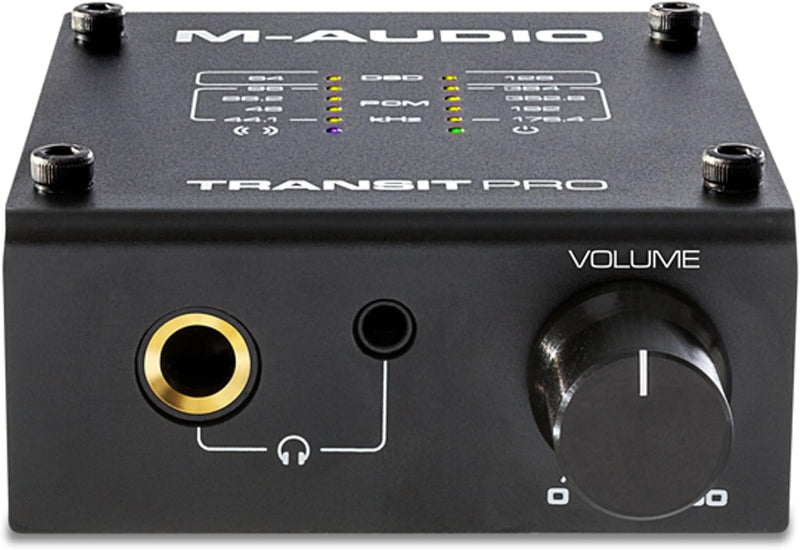
M-Audio Transit Pro USB-Optical DSD Converter
384kHz ceiling and 112dB SNR make the Transit Pro the cleanest USB-to-optical bridge for audiophile DAC chains that demand bit-perfect, DSD-capable signal conversion.
$244.38*
View on Amazon
✓ In Stock on Amazon.com
*Price sourced from Amazon.com. Last updated:Aug 30, 2026.Price and availability are subject to change — details.
Affiliate Disclosure: As an Amazon Associate, Studio Supplies earns from qualifying purchases made through links on this page, at no additional cost to you. This helps support our editorial team.
Notice a mistake? Let Us Know
Overview
Key Features
Super-high resolution USB to optical/DSD converter
Eight user-selectable sampling rates: 44.1, 48, 88.2, 96, 176.4, 192, 352.8, 384kHz
Signal-to-noise ratio: 112dB
Extremely low distortion: THD+N 0.003%
Digital (optical) and analog outputs
Specifications
Brand
M-Audio
Model
Transit Pro
Product Type
USB-Optical DSD Converter
Signal-to-Noise Ratio
112dB
Distortion (THD+N)
0.003%
Output Types
Digital (optical), Analog
Sampling Rates
44.1, 48, 88.2, 96, 176.4, 192, 352.8, 384kHz
Resolution
Super-high
Frequently Asked Questions
What does this converter actually do in a signal chain — where does it sit?
The Transit Pro sits between a computer USB output and a DAC or optical-input receiver. It converts the digital audio stream from USB format to S/PDIF optical (TOSLINK) or DSD output, allowing a computer to feed a DAC or amplifier that lacks a native USB input. If your DAC has an optical input but no USB, this unit bridges that gap without degrading the digital signal.
Does the 112dB signal-to-noise ratio apply to the digital output, the analog output, or both?
The 112dB SNR is the measured performance of the converter's analog output stage. For the digital optical output, SNR is theoretically infinite — a clean digital signal is either bit-perfect or it isn't. The analog output SNR of 112dB is the relevant specification for users routing the Transit Pro into an amplifier or powered monitor directly, representing an extremely quiet noise floor well below the threshold of audibility on any practical listening system.
Can this converter pass DSD content from a computer to a DSD-capable DAC?
Yes — DSD pass-through is a core function of the Transit Pro. It supports DSD transmission alongside PCM at rates up to 384kHz, making it suitable as the USB front-end for high-resolution DSD DACs that lack USB connectivity. The exact DSD rate support (DSD64, DSD128, DSD256) should be confirmed against your DAC's specifications.
Will this work on macOS without additional driver installation?
The product listing does not specify driver requirements by platform. USB audio converters in this class commonly operate as USB Audio Class 1 or Class 2 devices — Class 1 is driver-free on macOS and Windows 10+; Class 2 may require a driver on Windows. Confirm driver requirements with M-Audio before purchase if driver-free operation is a requirement.
What is the THD+N of 0.003% equivalent to in practical listening terms?
0.003% THD+N is approximately -90dB of total harmonic distortion plus noise relative to the signal level — well below the threshold of audibility for any harmonic distortion artifact. In practice, you will not hear distortion introduced by this converter. Any coloration in the downstream signal chain will originate from the DAC, amplifier, or transducer, not from this conversion stage.
Related Products


