



Mackie
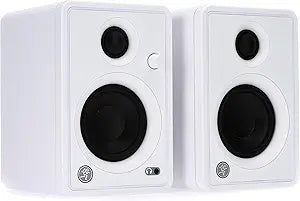
Mackie CR3-XLTD-WHT CR3-X 3" Multimedia Monitors - White (Pair)
Desktop reference monitoring with a true 3" woofer and balanced TRS input that brings honest low-midrange reproduction to project studio and home production setups.
Check availability
Affiliate Disclosure: As an Amazon Associate, Studio Supplies earns from qualifying purchases made through links on this page, at no additional cost to you. This helps support our editorial team.
Notice a mistake? Let Us Know
Overview
Key Features
RCA Inputs - White (pair)
3" Active Studio Monit
with 1/4" TRS
1/8" TRS
Specifications
Monitor Type
Active (powered) near-field desktop monitors
Woofer Size
3 inches
Configuration
Stereo pair
Inputs
1/4" TRS (balanced), 1/8" TRS, RCA
Volume Control
Front-panel knob
Finish
Limited-Edition White
Frequently Asked Questions
Do the CR3-X monitors require external amplification?
No — these are active (powered) monitors with built-in amplification. Each speaker in the pair is self-powered, so you connect them directly to your audio interface, mixer output, or computer headphone jack without an external amp or receiver in the signal chain.
What inputs are available, and which should I use for the best signal quality?
The CR3-X accepts three input types: 1/4" TRS (balanced), 1/8" TRS (unbalanced), and RCA (unbalanced). For connecting to a dedicated audio interface, use the 1/4" TRS input — balanced connections reject common-mode noise and are the correct choice whenever your interface provides balanced outputs. The 1/8" TRS and RCA inputs serve consumer sources like laptops, phones, and media players.
How is volume controlled on these monitors?
Volume is controlled via a front-panel knob, which is the correct design for a desktop monitoring setup — you don't need to reach behind the speaker or dive into software to trim levels. This also means the monitors can be used as a primary listening output without a hardware mixer in the chain.
Are these suitable as reference monitors for mixing and critical listening?
With a 3" woofer, low-frequency extension is physically limited — you will not hear accurate bass content below approximately 80Hz without a subwoofer. For critical mix decisions involving bass and kick drum, you need to supplement these with headphone checking or a sub. For high-midrange and treble accuracy, and for referencing a mix at realistic desktop listening levels, they perform credibly for their size class.
Does the limited-edition white finish affect the components or performance in any way?
No. The white finish is a cosmetic variant of the standard CR3-X; the driver, amplifier, and crossover components are identical to the standard black version. Performance is unchanged — you're choosing an aesthetic, not a different engineering spec.
Related Products


