



Mackie
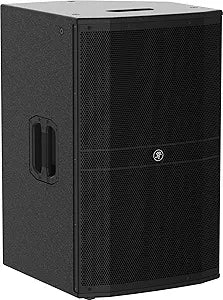
Mackie DRM215-P 15" Passive PA Speaker
Purpose-built passive muscle for demanding live stages, the DRM215-P pairs a titanium compression driver with a high-excursion 15" woofer to deliver headroom when your mix needs to breathe.
$699.99*
View on Amazon
✓ In Stock on Amazon.com
*Price sourced from Amazon.com. Last updated:Aug 28, 2026.Price and availability are subject to change — details.
Affiliate Disclosure: As an Amazon Associate, Studio Supplies earns from qualifying purchases made through links on this page, at no additional cost to you. This helps support our editorial team.
Notice a mistake? Let Us Know
Overview
Key Features
600-watt Passive PA Speaker with 15" High-excursion Woofer and 1.4" Titanium-diaphragm Compression Driver (each)
Specifications
Type
Passive PA Speaker
Power Handling
600 Watts
Woofer
15" High-Excursion
Compression Driver Diaphragm
1.4" Titanium
Cabinet Material
Plywood
Configuration
Passive (requires external amplification)
Frequently Asked Questions
What amplifier power rating does the DRM215-P require to operate safely?
Passive speakers should be driven with an amplifier rated between 1x and 2x the speaker's continuous power handling. For the DRM215-P's 600-watt rating, a dedicated amp in the 600–1200W range at the speaker's impedance is the professional target — underpowering it risks distortion under hard transients, while severe overpowering risks driver damage.
Does the DRM215-P have a built-in crossover, or does it require external processing?
The DRM215-P includes an internal passive crossover that routes signal appropriately between the 15" woofer and the titanium compression driver. No external active crossover is required for standard full-range use, though pairing with a DSP processor is common practice in professional installs for additional EQ and limiting.
Is the plywood cabinet construction meaningful for live touring use?
Plywood outperforms MDF in live touring contexts — it resists humidity swings that cause MDF to swell and delaminate, and it handles the vibration stress of regular loading cycles more reliably. The DRM215-P's plywood enclosure is a deliberate choice for road durability, not a cost-cutting measure.
Can the DRM215-P be used as a floor monitor?
The cabinet geometry and intended use case is front-of-house PA deployment. Whether it can be angled as a monitor depends on available rigging or wedge stand options — confirm with your system integrator. It is not marketed or optimized as a stage monitor.
What does the 1.4" titanium-diaphragm compression driver contribute to the sound?
Titanium diaphragms are stiffer and lighter than polyester equivalents, which extends high-frequency extension and improves transient articulation in the HF band. In a live mix, you hear this as better definition on cymbal crashes, sibilance, and upper harmonics of brass — frequencies that blur in less rigid drivers at high SPL.
Related Products


