

Mackie
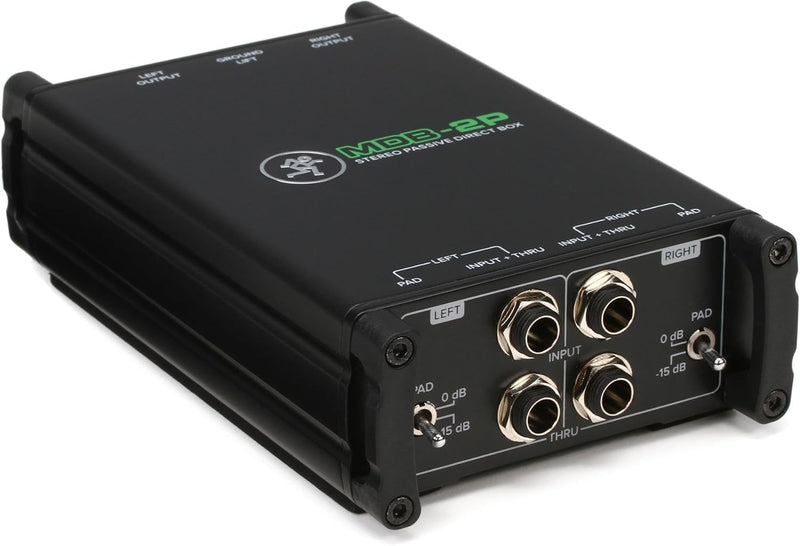
Mackie MDB-2P Stereo Passive DI Direct Box
XLR
Isolate and Balance Stereo Audio SignalsThe Mackie MDB-2P Stereo Passive Direct Box is an essential tool for musicians, sound engineers, and recording studios. It allows you to connect stereo sources like keyboards and synthesizers to mixing consoles or recording interfaces while maintaining sign...
$89.99*
View on Amazon
✓ In Stock on Amazon.com
*Price sourced from Amazon.com. Last updated:Aug 27, 2026.Price and availability are subject to change — details.
Affiliate Disclosure: As an Amazon Associate, Studio Supplies earns from qualifying purchases made through links on this page, at no additional cost to you. This helps support our editorial team.
Notice a mistake? Let Us Know
Overview
Isolate and Balance Stereo Audio Signals
The Mackie MDB-2P Stereo Passive Direct Box is an essential tool for musicians, sound engineers, and recording studios. It allows you to connect stereo sources like keyboards and synthesizers to mixing consoles or recording interfaces while maintaining signal integrity and reducing noise.
- Key Features:
- 2-channel Passive Direct Box with -15dB Pads.
- Independent XLR and 1/4" Thru Outputs.
- Ground Lift switch to eliminate hum and buzz.
Key Features
High-impedance 1/4" inputs with Thru outputs
Balanced XLR outputs with ground lift
Ultra-low noise and distortion
-15dB pads ensures Distortion-Free performance when connecting to high-output sources
Built-like-a-tank construction
Specifications
Inputs
High-impedance 1/4"
Outputs
Thru (1/4"), Balanced XLR
Pad
-15dB
Noise and Distortion
Ultra-low
Frequently Asked Questions
What types of inputs does the Mackie MDB-2P Stereo Passive DI Direct Box support?
The Mackie MDB-2P Stereo Passive DI Direct Box features high-impedance 1/4" inputs, allowing connection of various instruments and line-level sources.
Does this DI box help with ground loop issues?
Yes, it includes balanced XLR outputs with a ground lift switch, which is designed to help eliminate hum and buzz caused by ground loops.
Can the MDB-2P handle strong audio signals without distortion?
Yes, the Mackie MDB-2P is equipped with -15dB pads that ensure distortion-free performance even when connected to high-output sources.
Is this DI box built to withstand rigorous use?
The Mackie MDB-2P is described as having "built-like-a-tank" construction, indicating a robust and durable design suitable for professional use.
What kind of audio quality can be expected from this direct box?
The Mackie MDB-2P offers ultra-low noise and distortion, contributing to a clean and accurate audio signal.
Related Products


