



Meike
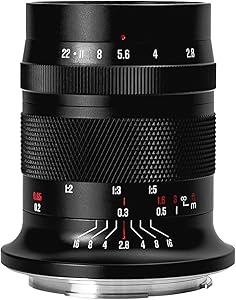
Meike 60mm f2.8 RF-Mount APS-C Macro Lens
Manual focus precision at true 1:1 macro brings insect details, product textures, and tabletop subjects to life on Canon RF APS-C bodies.
$179.99*
View on Amazon
✓ In Stock on Amazon.com
*Price sourced from Amazon.com. Last updated:Aug 28, 2026.Price and availability are subject to change — details.
Affiliate Disclosure: As an Amazon Associate, Studio Supplies earns from qualifying purchases made through links on this page, at no additional cost to you. This helps support our editorial team.
Notice a mistake? Let Us Know
Overview
Key Features
Compatible with Canon Camera Such as Canon RF Mount series Camera such as EOS-R EOS-RP R5 R5C R6 R7 R10
Lens construction: 8 groups 11 elements, aperture range of F2.8-F22, APS-C Angle of view: Diagonal 26.6°
With superior multi-layer nano-coating to reduce flare,the compact size lens body makes it easier to carry and use.
Great build quality with all metallic construction, making the lens solid, waterproof and dustproof
Lens Not Attached : MANUAL LENS need you to enable "M mode " or "Release without lens" in the setting of camera
Specifications
Focal Length
60mm
Maximum Aperture
f2.8
Minimum Aperture
f22
Mount Type
RF-Mount
Sensor Compatibility
APS-C
Angle of View (Diagonal)
26.6°
Lens Construction
8 groups, 11 elements
Coating
Multi-layer nano-coating
Construction Material
Metallic
Features
Waterproof, Dustproof
Frequently Asked Questions
Does this lens achieve true 1:1 macro magnification on APS-C Canon RF cameras?
Yes — the Meike 60mm f2.8 is designed for APS-C format and delivers true 1:1 macro magnification on crop-sensor Canon RF cameras such as the R7 and R10. This means the subject is reproduced on the sensor at life size, giving you the resolving detail that genuine macro work demands.
What camera setting is required to use this lens, since it has no electronic contacts?
Because this is a fully manual, contact-free lens, you must enable either "Shooting without lens" or "Release shutter without lens" in your Canon camera's menu — the exact menu label varies by body. Without enabling this setting, the camera will not fire the shutter. Set the camera to M or Av mode for full aperture control.
How does manual focus affect shooting macro subjects — is a focusing rail recommended?
At 1:1 macro distances, depth of field at f2.8 is razor thin and the focusing ring controls the subject plane very precisely. For static subjects — product, natural history specimens, tabletop — a focusing rail gives you more controlled magnification adjustment by moving the camera body rather than the focus ring alone. For living subjects like insects, manual focus requires practiced technique and patience.
Is the all-metal construction a practical durability advantage or mainly an aesthetic one?
The all-metal barrel construction provides genuine functional benefits: it resists the flex and play that develops in plastic-barreled lenses over time, and the weatherproof and dustproof design gives the lens real-world protection for outdoor macro work. The added weight is the trade-off.
What is the effective focal length equivalent on APS-C, and how does working distance compare to longer macro lenses?
On APS-C Canon RF, the 60mm focal length gives an equivalent field of view of approximately 96mm. At 1:1 macro, the working distance between the front element and the subject is moderate — closer than a 100mm macro would offer, which limits how much space you have to light the subject or position diffusion materials without casting lens shadow.
Related Products


