Miller

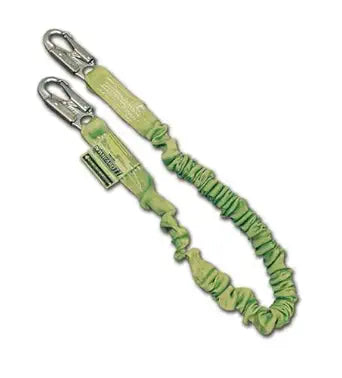
Miller 216M/6FTGN Manyard II Shock-Absorbing Lanyard

4.5 (12 reviews)

The Miller Manyard II's dual-layer construction — shock-absorbing inner core plus heavy-duty outer jacket — delivers redundant fall arrest protection on every job at height.

$174.91*
In Stock on Amazon.com
View on Amazon

*Price sourced from Amazon.com. Last updated:Jul 14, 2026.Price and availability are subject to change.

Affiliate Disclosure: Studio Supplies may earn a commission from qualifying purchases made through links on this page, at no additional cost to you. This helps support our editorial team.

Notice a mistake? Let Us Know

Overview

The Miller by Honeywell Manyard II is a 6-foot single-leg shock-absorbing lanyard engineered around a core design insight: a fall arrest event that injures the worker is a failure, even if the system holds. The shock-absorbing inner core addresses this by using a specially woven construction that deploys under arrest load — expanding progressively rather than transmitting the full stop-force as an instantaneous shock. This energy absorption is what separates the Manyard II from basic lanyards and what makes it compliant with ANSI Z359 and OSHA requirements for personal fall arrest systems that limit maximum arrest force to 1,800 lbs on the harness. The heavy-duty tubular outer jacket that surrounds this inner core adds a second layer of structural integrity — it is designed to function as a backup lanyard in the event the primary energy-absorbing core deploys, providing genuine redundancy in a single integrated unit.

The integral bright red inner core is a field-practical engineering decision: damage to the outer jacket from abrasion, chemical exposure, UV degradation, or tool cuts is immediately visible during pre-use inspection without disassembly or specialized equipment. For workers who clip on at the start of a shift without extended inspection time, this visual indicator removes a significant ambiguity. The stretchable web body balances mobility and working length — it allows workers to reposition without constantly re-managing slack, which matters during tasks like steel erection, roofing, or tower maintenance where body position changes frequently. The two locking snap hooks on the single-leg configuration provide secure engagement at both the harness dorsal ring and the anchor connector, with gate mechanisms that require deliberate actuation to release.

Key Features

Manyard II shock-absorbing stretchable web lanyard

Specially-woven shock-absorbing inner core smoothly expands out, reducing fall arrest forces

Heavy-duty tubular outer jacket serves as a back-up lanyard

Integral bright red core makes visual inspection easier and more reliable

Availabel in green color

Specifications

Brand
Miller by Honeywell
Model
216M/6FTGN
Type
Shock-Absorbing Lanyard
Length
6 feet
Configuration
Single Leg
Snap Hooks
2 Locking Snap Hooks
Body Material
Stretchable Web
Inner Core
Shock-Absorbing (integral bright red)
Outer Jacket
Heavy-Duty Tubular (backup lanyard function)
Color
Green

Pros & Cons

👍 Pros

  • The shock-absorbing inner core's smooth expansion during arrest reduces peak force on the harness and anchor compared to rigid lanyards — a meaningful safety margin on older or imperfect anchor structures.
  • The heavy-duty tubular outer jacket functions as an independent backup lanyard in the event the inner core deploys, providing two levels of structural redundancy in one unit.
  • The integral bright red core makes damage visible at a glance during pre-shift inspection — torn or abraded outer jacket immediately reveals the compromised status without requiring detailed probing.
  • The stretchable web body allows natural movement and repositioning on the job without constant slack management — easier to work with during tasks that require changing body position frequently.
  • Single-leg configuration with two locking snap hooks provides straightforward 100% tie-off capability when used with a compatible Y-lanyard or double-hook anchor arrangement.

👎 Cons

  • Once the shock-absorbing inner core deploys during an actual fall arrest, the entire lanyard must be retired and replaced — it is single-use for fall arrest events, which adds to the cost of ownership over time.
  • The 6-foot length requires significant fall clearance below the anchor — in environments with limited vertical clearance, a shorter SRL (self-retracting lifeline) may be a safer alternative.
  • The stretchable web body can accumulate dirt and contaminants more readily than a round-braid lanyard, requiring more thorough post-use cleaning in dusty or chemical environments.
  • Green color, while ANSI-compliant and visible, is not a universal color indicator — workers transitioning from systems that use color coding for equipment status should verify their site's color management conventions.

Frequently Asked Questions

The Manyard II's specially-woven inner core is designed to smoothly expand and decelerate during a fall, reducing the peak arrest force transmitted to the harness and the anchor point. A standard lanyard has no energy-absorbing mechanism and transmits the full arrest force as a sharp shock — a force that can injure the wearer even in a successfully arrested fall.
The Manyard II is a 6-foot single-leg lanyard, which means it requires an anchor point at least 18.5 feet above the lower level when accounting for lanyard length, deceleration distance, and the wearer's height — standard OSHA and ANSI Z359 fall clearance calculation requirements apply.
The bright red inner core becomes visible if the outer jacket is cut, abraded, or torn. This visual indicator makes damage immediately obvious during pre-use inspection — you do not need to flex or probe the lanyard to detect compromised protection.
The Manyard II ships with two locking snap hooks — one at each end of the single-leg configuration. Both hooks are self-locking to prevent accidental gate opening under load.
The stretchable construction means the working length varies slightly under tension — the 6-foot rating applies to the deployed arrest length, not a relaxed hang length. The elasticity is a feature, not a tolerance issue; it allows more natural movement while positioning without creating a constantly taut connection.