



Monoprice
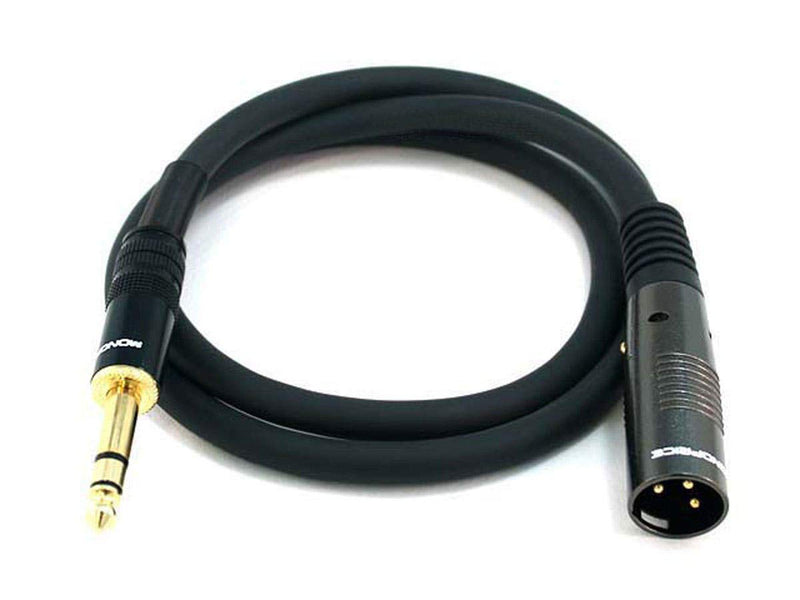
Monoprice 104760 XLR to 1/4" TRS Cable 3ft
★★★★★
4inXLR
Clean, interference-free balanced signal from console to stage — this 3ft Monoprice Premier XLR to TRS cable is built for the session grind.
$12.99*$15.48Save 16%
View on Amazon
✓ In Stock on Amazon.com
*Price sourced from Amazon.com. Last updated:Jul 14, 2026.Price and availability are subject to change.
Affiliate Disclosure: Studio Supplies may earn a commission from qualifying purchases made through links on this page, at no additional cost to you. This helps support our editorial team.
Notice a mistake? Let Us Know
Overview
Key Features
Balanced cables have a separate braided shield to provide additional resistance to interference without modulating the interference into the signal.
Prevents ground loop issues.
XLR to 1/4in TRS balanced pro audio cables provide high fidelity and eliminate noise in the recording studio and on the stage.
Our new premier series cables up the ante in terms of construction quality and performance.
Specifications
Cable Type
XLR Male to 1/4" TRS Male
Length
3 Feet
Gauge
16AWG
Connectors
Gold Plated
Shielding
Separate Braided Shield
Signal Type
Balanced Audio
Strain Relief
Molded Boots
Series
Premier Series
Pros & Cons
👍 Pros
- Separate braided shield effectively rejects RFI and EMI interference, keeping the noise floor clean even in electrically noisy live environments.
- Balanced construction eliminates ground loop hum when bridging XLR and TRS balanced gear in studio racks or FOH setups.
- Gold-plated connectors resist corrosion and oxidation, maintaining low contact resistance through repeated insertions over years of use.
- Molded strain relief boots protect the solder joints at both ends — the failure point most budget cables skip.
- 16AWG conductor construction gives the cable mechanical durability on stage floors and in tight rack patches.
👎 Cons
- At 3 feet, this is a short-run patch cable — not suitable as a main stage or studio send cable for longer distances.
- XLR end is male-only, limiting use cases to specific signal routing directions where a female XLR output is already present.
- No published capacitance specification makes it harder to assess high-frequency performance in critical monitoring chains.
- The Premier Series sits at entry-level professional pricing, so build consistency across batches can vary compared to boutique cable brands.
Frequently Asked Questions
What is the advantage of using a balanced XLR-to-TRS cable over an unbalanced alternative in a studio or live setting?
Balanced cables carry the audio signal on two conductors in opposite polarity, plus a separate braided shield. Any interference picked up along the cable is present on both conductors equally; the differential input at the destination cancels it out. In practice, you hear a quieter noise floor — especially over longer runs near power transformers, stage lighting dimmers, or dense rack environments.
Does this cable prevent ground loop hum between my interface and outboard gear?
Yes. The separate braided shield on this Monoprice Premier Series cable is designed specifically to resist ground loops. When connecting balanced XLR outputs (from a preamp, DI box, or stage snake) to a balanced TRS input on an interface or mixer, you avoid the characteristic 60Hz hum that plagues unbalanced connections sharing imperfect grounds.
Is this cable suitable for connecting a microphone directly to an interface?
The XLR end is male, so this cable is designed for line-level balanced signal routing — connecting preamp outputs to interface inputs, patchbay to processor, or stage box to console, not mic-to-interface. For microphone connections, you'd want a female XLR on at least one end.
Will the gold-plated connectors affect audio quality or just corrosion resistance?
Primarily corrosion resistance. Gold plating on the connector contacts maintains low contact resistance over time and repeated insertions, which matters in stage environments with humidity and sweat. Sonically, a well-seated gold contact versus a clean nickel contact is indistinguishable — the benefit is long-term reliability of that clean signal.
Does the 16AWG gauge matter at 3 feet?
At 3 feet, cable resistance is negligible for audio purposes. The 16AWG conductor is a positive construction indicator — heavier gauge means more durable cable under mechanical stress, which is what you want on a stage floor or in a frequently-patched rack.
Related Products


