



Monoprice
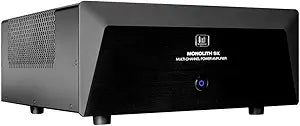
Monoprice 133306 Monolith 9-Channel Home Theater Amplifier
Nine channels of Class AB amplification — 200W on the front three, 100W across six surrounds — built to deliver honest dynamic range to every seat in the room.
$2,199.99*
Check availability
*Price sourced from Amazon.com. Last updated:Oct 21, 2026.Price and availability are subject to change — details.
Affiliate Disclosure: As an Amazon Associate, Studio Supplies earns from qualifying purchases made through links on this page, at no additional cost to you. This helps support our editorial team.
Notice a mistake? Let Us Know
Overview
Key Features
Power: the Monolith 9x is a 9-channel amplifier comprised of 200 watts per channel into 3 channels, and 100 watts per channel into 6 channels of amplification. This rating is measured with all channels Driven across the full power bandwidth of 20Hz to 20kHz into 8-ohm loads. Additionally, there is no current Limiting and there is no protection circuitry in the amplifier circuit path. Even if the speakers' Impedance drops to a low level, The Monolith is robust enough that the current is never
Dynamics: high Resolution Audio delivers the best in music and movie soundtracks. You deserve an amplifier Capable of delivering clear and clean audio across a wide dynamic range! With a more than 100dB signal to noise Ratio, The Monolith 9x can clearly and accurately articulate The quietest portions, the loudest portions, and everything in between
Class AB: more efficient than Class A, many high end, audiophile grade amplifiers utilize a class AB design
Made in U.S.A.: The Monolith 9x is designed, engineered, and assembled in the United States of America
Two toroidal transformer: no, these aren't new villains in the next giant robot movie, these are the source of an amplifier's power. Each amplifier channel gets its own set of transformer windings, and also its own storage capacitor. Essential, each channel has its own power supply meaning if one channel gets maxed out, the other channels are not affected
Specifications
Amplifier Type
Class AB
Channels
9 (3 x 200W + 6 x 100W into 8 Ohms)
Power Bandwidth
20Hz – 20kHz (all channels driven)
Signal-to-Noise Ratio
>100dB
Inputs
XLR (balanced) and RCA (unbalanced)
Power Supply
Dual toroidal transformers, per-channel isolation
Origin
Designed, Engineered, Assembled in U.S.A.
Model
133306
Frequently Asked Questions
What is the actual channel power configuration and how is it measured?
The Monolith 9x delivers 200 watts per channel into three channels and 100 watts per channel into six channels — all rated with all channels driven simultaneously, across the full 20Hz–20kHz bandwidth into 8-ohm loads. This is a meaningful distinction: many amplifiers publish single-channel burst ratings that collapse under multi-channel load. The Monolith 9x's all-channels-driven spec reflects real-world home theater operation.
Does this amplifier have any protection circuitry in the signal path?
No — Monoprice explicitly states there is no current limiting and no protection circuitry in the amplifier circuit path. This is an audiophile design choice: protection relays and current-limiting circuits introduce audible artifacts and slow transient response. The trade-off is that the amplifier relies on proper system matching and source components to avoid overdriving outputs.
What input types does the Monolith 9x accept?
It accepts both XLR (balanced) and RCA (unbalanced) inputs across all nine channels. Balanced XLR connections provide common-mode noise rejection — particularly valuable in longer cable runs between a processor and amplifier, where RCA connections can pick up hum and interference in the signal path.
What is the signal-to-noise ratio and why does it matter for home theater?
The SNR exceeds 100dB, which means the noise floor is effectively inaudible in a properly set up home theater environment. A high SNR is critical for home theater because surround formats demand both whisper-quiet ambience and explosive transient peaks — an amplifier with a lower SNR audibly hisses during quiet passages, destroying the dynamic contrast that makes film sound immersive.
What is the power supply topology and why does it matter for sustained output?
Each channel receives its own dedicated transformer winding and storage capacitor from two toroidal transformers. This per-channel power supply isolation means one channel drawing maximum current — during a bass-heavy explosion, for example — does not sag the rail voltage available to adjacent channels, preserving output quality across all nine channels simultaneously.
Related Products


