



Monoprice
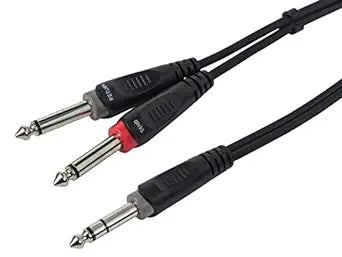
Monoprice 601051 1/4" TRS to Dual 1/4" TS Insert Cable
Connect Your Effects Processors with PrecisionThe Monoprice 1/4 Inch TRS Male to two 1/4 Inch TS Male Insert Cable provides a reliable connection between your mixing board and external effects processors, ensuring a seamless audio workflow. Connectors: 1/4" TRS Male to two 1/4" TS Male Conduct...
$9.99*
View on Amazon
✓ In Stock on Amazon.com
*Price sourced from Amazon.com. Last updated:Aug 30, 2026.Price and availability are subject to change — details.
Affiliate Disclosure: As an Amazon Associate, Studio Supplies earns from qualifying purchases made through links on this page, at no additional cost to you. This helps support our editorial team.
Notice a mistake? Let Us Know
Overview
Connect Your Effects Processors with Precision
The Monoprice 1/4 Inch TRS Male to two 1/4 Inch TS Male Insert Cable provides a reliable connection between your mixing board and external effects processors, ensuring a seamless audio workflow.
- Connectors: 1/4" TRS Male to two 1/4" TS Male
- Conductors: 26AWG with copper braid shielding
Key Features
26AWG conductors with copper braid shielding
1/4" TRS male plug on one end and two color-coded 1/4" TS male plugs on the other end
Quality at a Fair Price: Monoprice's rugged design and rigid quality control standards deliver high quality products at fair prices.
Specifications
Conductor Gauge
26AWG
Shielding
Copper braid
Connector 1
1/4" TRS male plug
Connector 2
Two color-coded 1/4" TS male plugs
Frequently Asked Questions
What is this cable actually used for in a signal chain?
An insert cable splits a single TRS jack into separate send and return paths. You plug the TRS end into your mixer's insert point, then route the TS send to your outboard processor's input and the TS return from its output — this lets you patch hardware compressors, EQs, or gates directly into a channel strip.
Does the 26AWG conductor gauge affect signal quality for pro audio use?
At typical insert cable lengths, 26AWG is a reasonable gauge for line-level signal transfer. You won't hear degradation in transient response or headroom from the conductor gauge alone — the more critical factor is the copper braid shielding, which guards against EMI and hum pickup in a busy studio or live rack.
Will this cable work with balanced insert points?
Insert points are by definition unbalanced — the TRS jack uses tip (send) and ring (return) as two separate unbalanced signal paths, not a balanced pair. This cable is correctly wired for that application. Do not use it as a balanced TRS interconnect.
How do I know which TS plug is send and which is return?
The two TS plugs are color-coded, which is the practical advantage over uncolored alternatives. Convention is typically red for send (tip of the TRS) and black or white for return (ring of the TRS), but verify against your specific unit before patching.
Is this suitable for live mixing rigs or studio use only?
Both. The copper braid shielding makes it appropriate for live racks where interference is higher. The construction is straightforward enough that it's a reliable road cable, though for touring rigs you'd want to inspect the strain relief periodically.
Related Products


