



Moog
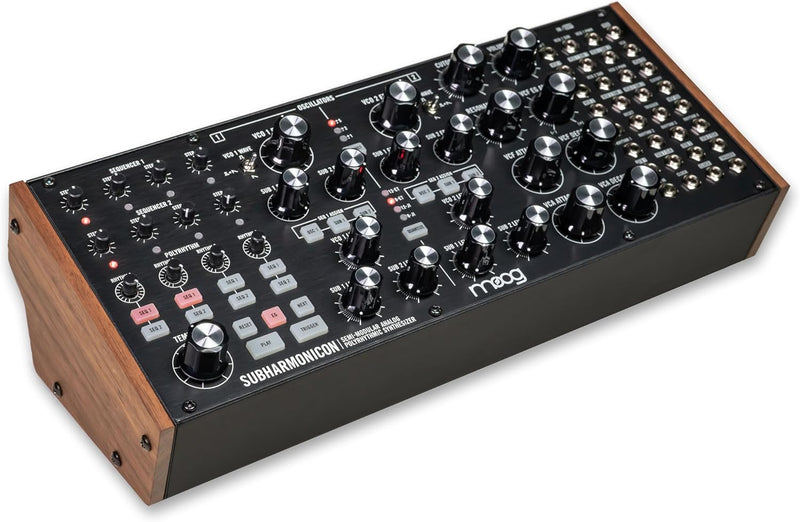
Moog MOD-SUBH Subharmonicon Semi-Modular Analog Synthesizer
Moog's Subharmonicon unlocks polyrhythmic analog synthesis with six tonal sources and dual four-step sequencers.
$499.00*$599.00Save 16%
View on Amazon
✓ In Stock on Amazon.com
*Price sourced from Amazon.com. Last updated:Aug 27, 2026.Price and availability are subject to change — details.
Affiliate Disclosure: As an Amazon Associate, Studio Supplies earns from qualifying purchases made through links on this page, at no additional cost to you. This helps support our editorial team.
Notice a mistake? Let Us Know
Overview
Key Features
Six Tonal Sources - 2 Voltage Controlled Oscillators each with 2 subharmonic generators provide a dense harmonic bed of sound
Four Rhythm Generators - Each rhythmic source can drive either sequencer (or both) for surprising and unexpected polyrhythms
Two Sequencers - Each four-step sequencer can drive any combination of its associated VCO and subharmonic generators
Exponentially Expandable - Combine with Labyrinth, Spectravox, Mother-32, or DFAM to unlock new realms of sound, imagination, and creativity
Eurorack Flexibility - Use as a tabletop synthesizer or install as a 60HP module in an Eurorack system
Endless Sonic Exploration - Expansive live performance and production synthesizer, providing experimental musicians and synthesists with a diverse array of creative tools to inspire new ideas
Delve into Subharmonicon - Call up dynamic articulations ranging from lush pads and blurred edges to percussive plosives and ritualistic rhythms
Specifications
Oscillators
2 Voltage Controlled Oscillators (VCOs)
Subharmonic Generators
4 (2 per VCO)
Total Tonal Sources
6
Rhythm Generators
4
Sequencers
2 four-step sequencers
Synthesis Type
Semi-modular analog
Form Factor
Tabletop or 60HP Eurorack module
Patch Bay
Yes (3.5mm)
Compatible With
Mother-32, DFAM, Labyrinth, Spectravox, Eurorack systems
Frequently Asked Questions
What makes the Subharmonicon different from a standard analog synthesizer?
The Subharmonicon is built around subharmonic generation and polyrhythmic sequencing — its two VCOs each have two subharmonic oscillators that divide frequencies downward, and four rhythm generators create interlocking polyrhythms, producing sounds and patterns that conventional synths cannot easily achieve.
Can the Subharmonicon be used in a Eurorack setup?
Yes, it functions as either a standalone tabletop synthesizer or as a 60HP Eurorack module, so you can integrate it directly into an existing modular system.
Does the Subharmonicon have a patch bay?
Yes, as a semi-modular synthesizer, it includes a patch bay that lets you override the default signal routing and connect individual modules in custom configurations using standard 3.5mm patch cables.
How many sequencer steps does the Subharmonicon have?
It has two four-step sequencers, each of which can drive any combination of its associated VCO and subharmonic generators for melodic and rhythmic variation.
Can the Subharmonicon connect to other Moog semi-modular synthesizers?
Yes, it is designed to pair with other Moog semi-modulars like the Mother-32, DFAM, Labyrinth, and Spectravox via patch cables, expanding the available sound-design possibilities significantly.
Related Products


