



Neewer
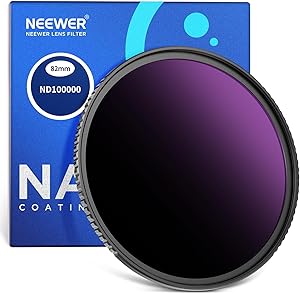
Neewer 10102955NE 82mm ND100000 Ultra Dark ND Filter
★★★★★
Shoot the sun safely — this 16.5-stop ND100000 filter lets you photograph solar events with razor-sharp detail and no overexposure.
$45.49*
Check availability
*Price sourced from Amazon.com. Last updated:Jul 14, 2026.Price and availability are subject to change.
Affiliate Disclosure: Studio Supplies may earn a commission from qualifying purchases made through links on this page, at no additional cost to you. This helps support our editorial team.
Notice a mistake? Let Us Know
Overview
Specifications
Filter Type
ND100000 (Neutral Density)
Light Reduction
16.5 stops
Filter Diameter
82mm
Glass Material
HD Optical Glass
Coating
Multi-Resistant Coating (30 layers)
Frame Material
CNC Machined Aluminum Alloy
Frame Design
Ultra Slim
Coating Properties
Water Repellent, Oil Resistant, Scratch Resistant
Pros & Cons
👍 Pros
- Rated ND100000 / 16.5 stops — precise density needed for safe solar and transit photography without sensor damage.
- 30-layer multi-resistant coating resists dust, moisture, and oil smear during outdoor celestial events where recoating isn't an option.
- CNC-machined aluminum alloy frame threads securely without the flex or slip of cheaper plastic-mount filters.
- Ultra-slim profile reduces the frame shadow and vignetting that thicker solar filters introduce on longer telephoto lenses.
- HD optical glass maintains edge-to-edge sharpness so fine solar surface detail — sunspots, limb darkening — renders clearly.
👎 Cons
- Single-purpose tool — the ND100000 density has almost no application outside solar and extreme celestial photography.
- At 82mm, the filter is sized for large telephoto lenses; photographers shooting solar events on smaller kit lenses will need step-down adapters.
- Color cast is common in ultra-dense ND glass; expect minor white balance adjustment needed in post for accurate solar color rendition.
- No filter pouch or hard case included — a filter this specialized and fragile warrants dedicated storage that must be sourced separately.
Frequently Asked Questions
What exactly can I photograph with a 16.5-stop ND100000 filter?
This filter is purpose-built for solar photography — partial and total solar eclipses, solar transits (Venus, Mercury), and sunspot observation. It reduces incoming light so drastically that the sun becomes a manageable subject rather than a sensor-destroying hazard. It is not a general-purpose long-exposure filter.
Can I use this filter for daytime long exposures or waterfalls?
No — 16.5 stops is far beyond what you'd need for typical long-exposure work (ND8 to ND1000 handles that). At ND100000, even a sunny outdoor scene would require exposures measured in hours. This is a specialist solar filter; treat it as one.
Does the slim frame cause vignetting on wide-angle lenses?
The ultra-slim CNC aluminum frame is designed to minimize vignetting, and at 82mm it threads onto large-diameter lenses where vignetting is already less of a concern. On lenses wider than about 24mm full-frame equivalent, some vignetting is possible — check your specific lens before a critical shoot.
How do the 30-layer multi-resistant coatings affect image quality during solar photography?
The MRC stack repels water, oil, and dust — all of which become high-contrast problems when you're photographing a bright disk against dark sky. Clean glass is critical for solar detail; these coatings make field cleaning faster and reduce the risk of smearing that could ruin fine solar surface texture.
Is it safe to use this filter for visual observation through a DSLR viewfinder?
Never use any camera-mounted filter — including this one — for direct eye-to-viewfinder solar observation. Always use Live View on a tilted screen. This filter is rated for camera sensors and lenses, not for the human eye at the eyepiece.
Related Products


